Choosing among the best resin printers for prototypes means balancing detail, build volume, speed, reliability, and the practical cost of resin and post-processing. The right machine can turn digital concepts into accurate physical parts for fit checks, presentation models, and functional testing.
We selected 10 resin printers spanning compact desktop options and larger, faster machines. Use the comparison and buying advice below to match resolution, workflow features, and capacity to your prototyping needs.
Best 10 Resin Printers for Prototypes Picks for 2026
Best Large-Format Pick

- 18.3L build volume for oversized prototypes and batch runs
- 14-inch 12K screen for smooth, detailed surfaces
- Heated 1,900 ml resin tank and automatic leveling
Best For: Large prototypes and high-volume production
Best Balanced Choice

- 10-inch 12K LCD captures fine prototype details
- Generous 218.88 × 122.88 × 250 mm build area
- Uniform COB/Fresnel light source and broad slicer support
Best For: Detailed desktop prototypes
Best for Fine Precision

- 16K LCD with 14 × 19 μm XY resolution
- 385nm source supports detailed and transparent models
- Heating, auto-feeding, and app-based monitoring
Best For: Precision prototypes and transparent models
Best for Industrial Resin Compatibility

- Handles resins up to 8,000 cps
- 14K screen supports crisp fine details
- Auto-leveling and AI monitoring simplify operation
Best For: Engineering prototypes and high-viscosity resins
Best High-Speed Detail

- 16K LCD with 14 × 19 μm XY resolution
- Print speeds up to 150 mm/h
- AI camera, sensors, and heated resin tray
Best For: Detailed prototypes and larger production runs
Best Precision Workflow
Reflex RS Turbo Resin 3D Printer

- High-contrast amber screen for detailed curing
- 2 μm claimed repeat positioning accuracy
- Automated slicing, leveling, and diagnostics
Best For: Precision-focused engineering prototypes
Best All-Around Value
ELEGOO Saturn 4 Ultra 16K Resin Printer

- 16K LCD with 14 × 19 μm XY resolution
- 8.33 × 4.66 × 8.66-inch build area
- Heated tank, AI camera, and auto-leveling
Best For: High-resolution prototypes with easy setup
High-Detail Beginner Pick

- 9K LCD with 18 μm XY resolution
- Factory pre-leveled platform
- USB, Wi-Fi, and Creality Cloud transfers
Best For: Beginners making detailed small prototypes
Fast Connected Workhorse

- 9K detail at 18 × 18 μm XY resolution
- Printing speeds up to 150 mm/h
- AI camera and Wi-Fi cluster printing
Best For: Connected workflows and faster prototype cycles
Simple Safety-Focused Option
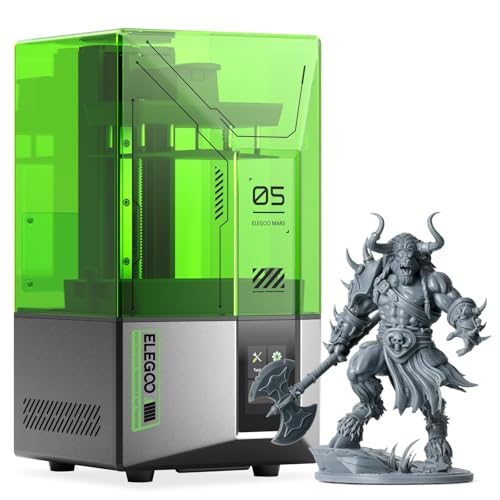
- One-click automatic leveling
- 4K mono LCD with COB light source
- Self-check, residue detection, and overheat protection
Best For: Beginners making compact desktop prototypes
Best Large-Format Pick – ANYCUBIC Photon P1 Max
For resin printers for prototypes that need substantial scale or batch capacity, the ANYCUBIC Photon P1 Max stands out with its 18.3L build volume. Its 14-inch 12K screen, heated resin tank, and automated leveling are aimed at producing detailed parts with less setup friction.
Best For: Large prototypes, oversized models, and high-volume batch production.
Pros:
- Large 285.5 × 214 × 300 mm build volume supports oversized or densely packed prints.
- 14-inch 12K monochrome screen provides fine 24.8 × 24.8 μm square pixels.
- Temperature-controlled 1,900 ml resin tank can heat resin up to 35°C.
- Auto-Leveling 3.0 includes self-checking and real-time force feedback.
Cons:
- Its large 68.9-pound body requires substantial workspace and sturdy placement.
- The large-format design may be more printer than needed for small prototypes.
The P1 Max is a strong choice when prototype size and throughput matter most. Its heated vat and automated calibration also make it practical for workshops where consistent operation is a priority.
Best Balanced Choice – ELEGOO Saturn 3 12K
The ELEGOO Saturn 3 is a practical option among resin printers for prototypes when you want a generous desktop-sized build area and high-resolution output. Its 10-inch 12K monochrome LCD, uniform light source, and flexible slicer support suit detailed prototype work.
Best For: Detailed desktop prototypes and larger one-off models.
Pros:
- 218.88 × 122.88 × 250 mm build volume accommodates relatively large models.
- 12K monochrome LCD delivers 19 × 24 μm XY resolution.
- COB and Fresnel optics provide over 90% light uniformity.
- Laser-carved build plate promotes strong print adhesion.
Cons:
- Its 33-pound weight and 22.13-inch height still require dedicated workspace.
- The supplied features do not include automated resin heating or leveling.
With up to 70 mm/h printing and support for CHITUBOX, Lychee, and open-source GOO workflows, the Saturn 3 offers a well-rounded platform for prototype makers who value detail without moving to an especially large machine.
Best for Fine Precision – UniFormation GK3 Pro 16K
For resin printers for prototypes where micro-detail and transparent parts are important, the UniFormation GK3 Pro combines a 16K display with a 385nm light source. Automatic heating, resin feeding, and app control add useful workflow support for professional or small-batch work.
Best For: High-detail engineering prototypes, transparent models, and monitored small-batch production.
Pros:
- 16K LCD with 14 × 19 μm XY resolution targets highly detailed surfaces.
- 385nm curing light is designed to reduce scattering and over-curing.
- Automatic resin heating supports printing at temperatures as low as 5°C/41°F.
- App enables remote monitoring, control, and multi-printer management.
Cons:
- The 8.3 × 4.7 × 9.5-inch build volume is smaller than the P1 Max and Saturn 3.
- At 53.7 pounds, it is relatively heavy for its build capacity.
The GK3 Pro is compelling when surface fidelity and process control outweigh maximum part size. Its rigid Z-axis system, heated resin workflow, and remote monitoring are particularly useful for repeatable prototype production.
Best for Industrial Resin Compatibility – ANYCUBIC Photon P1 14K
The ANYCUBIC Photon P1 is a capable choice among resin printers for prototypes when material flexibility and dependable operation are priorities. It combines 14K detail with support for resins up to 8,000 cps, while automated leveling and AI checks help simplify the printing routine.
Best For: Engineering prototypes using high-viscosity or industrial resins.
Pros:
- Supports ultra-high-viscosity resins up to 8,000 cps.
- 14K mono LCD provides 16.8 × 24.8 μm pixel size and fine detail reproduction.
- Wave Release Technology reportedly reduces plate release force by 60%.
- AI monitoring checks plate installation, layer separation, resin level, and vat residue.
Cons:
- Its 8.78 × 4.96 × 9.05-inch build area is not intended for oversized prototypes.
- The product dimensions indicate a broad footprint for its desktop build volume.
The Photon P1 makes the most sense for makers and engineers who need to work with demanding, viscous materials without sacrificing fine detail. Its factory calibration and monitoring features further reduce routine setup and inspection.
Best High-Speed Detail – ELEGOO Saturn 4 Ultra 16K
For resin printers for prototypes that need fine detail without overly long production cycles, the ELEGOO Saturn 4 Ultra 16K combines a 16K mono LCD, tilt-release technology, and a claimed print speed of up to 150 mm/h. Its large build area also accommodates sizeable prototype parts or multiple smaller models.
Best For: Detailed prototypes, larger batches, and users who want automated monitoring and temperature control.
Pros:
- 16K resolution with 14 × 19 μm XY resolution supports highly detailed prints.
- Tilt-release technology and fast mode can reach printing speeds of up to 150 mm/h.
- Smart mechanical sensors, automatic leveling, power-loss recovery, and an AI camera help monitor jobs.
- Built-in heating maintains resin at a target temperature of 25°C.
Cons:
- At 40.7 pounds, it is a substantial printer for a small workspace.
- The many automated features may be more than casual users need.
This is a strong prototype-oriented choice when detail, build volume, and workflow automation matter. The 16K screen and heated resin system are particularly useful for repeatable, intricate parts.
Best Precision Workflow – Reflex RS Turbo Resin 3D Printer
The Reflex RS Turbo is built for resin printers for prototypes where dimensional consistency and a streamlined workflow are priorities. Its high-contrast amber screen, precision Z-axis, pre-tuned profiles, and automated model preparation are aimed at reducing setup and print-failure issues.
Best For: Engineering prototypes and users who value repeatable positioning, automated preparation, and detailed diagnostics.
Pros:
- High-contrast amber screen is designed for crisp details, dimensional accuracy, and faster curing.
- One-click slicing can repair several model defects and generate supports automatically.
- Industrial-grade C5 ball-screw Z-axis provides claimed repeat positioning accuracy of 2 μm.
- Force sensors can detect resin residue, pause prints, and generate a diagnostic report.
Cons:
- At 50.6 pounds, it is the heaviest option in this roundup.
- Its advanced workflow and controls may be unnecessary for simple hobby projects.
The RS Turbo stands out for prototype work that benefits from precise Z-axis movement and failure monitoring. Its pre-tuned, plug-and-play approach may also shorten the path from model file to finished part.
Best All-Around Value – ELEGOO Saturn 4 Ultra 16K Resin Printer
For buyers comparing resin printers for prototypes, this ELEGOO Saturn 4 Ultra 16K offers a practical mix of high resolution, fast printing, and automatic job monitoring. Its heated resin tank and auto-leveling features are useful when consistent results matter across repeated prototype runs.
Best For: Users who want high-resolution prototypes with simple setup, Wi-Fi transfer, and temperature-assisted printing.
Pros:
- 16K mono LCD delivers 15120 × 6230 pixel resolution and 14 × 19 μm XY resolution.
- Build volume of 8.33 × 4.66 × 8.66 inches supports large or multiple prototype parts.
- Heated resin tank automatically activates below 25°C to help maintain printing conditions.
- AI camera, automatic leveling, power-on resume, Wi-Fi transfer, and startup self-check simplify operation.
Cons:
- Its 35.4-pound weight and tall form factor require a stable, dedicated location.
- The feature set may be excessive if you only print occasional small models.
This model is a well-rounded option for prototype users who want strong detail without giving up convenience. Its combination of a large build area, claimed 150 mm/h speed, and automated safeguards makes it suited to repeatable work.
High-Detail Beginner Pick – HALOT-X1 Neo
For makers seeking resin printers for prototypes, the Creality HALOT-X1 Neo combines sharp 9K detail with a beginner-friendly setup. Its pre-leveled platform, flexible file transfer, and compact build area suit small, intricate prototype work.
Best For: Beginners, miniature creators, tabletop gamers, and DIY makers producing detailed small prototypes.
Pros:
- 9K LCD and 18 μm XY resolution capture fine model details.
- Factory pre-leveled build platform simplifies initial setup.
- Supports USB, 2.4GHz Wi-Fi, and Creality Cloud transfers.
- AI-powered 2D-to-3D generation can turn images into models.
Cons:
- The 153.36 × 77.76 × 160 mm build volume limits larger prototypes.
- AI model generation is tied to the FanForge workflow.
The HALOT-X1 Neo is a practical choice when fine detail and easy startup matter more than a large build area. Its connectivity options also make it adaptable to different slicing and transfer workflows.
Fast Connected Workhorse – ELEGOO Mars 5 Ultra
The ELEGOO Mars 5 Ultra is one of the more productivity-focused resin printers for prototypes, pairing 9K resolution with tilting release technology rated for printing speeds up to 150 mm/h. Automatic leveling, monitoring, and network controls can streamline repeat jobs.
Best For: Makers who need detailed prototypes, faster print cycles, remote monitoring, or multi-printer control.
Pros:
- 9K monochrome LCD provides 18 × 18 μm XY resolution.
- Tilting release technology supports speeds up to 150 mm/h.
- AI camera helps monitor prints and record time-lapse footage.
- Automatic leveling, self-checks, and mechanical sensing support easier operation.
Cons:
- Its 6.04 × 3.06 × 6.49 inch print size may not suit larger prototypes.
- The printer is substantially heavier than the compact HALOT-X1 Neo.
Choose the Mars 5 Ultra if throughput and oversight are central to your workflow. Wi-Fi transfer, 2.4G/5G compatibility, and cluster printing make it especially appealing for connected production setups.
Simple Safety-Focused Option – ELEGOO Mars 5
The ELEGOO Mars 5 keeps resin prototyping approachable with one-click automatic leveling, a self-check routine, and a 4K monochrome LCD. It is suited to makers who want dependable desktop features without prioritizing the higher resolution of the Mars 5 Ultra.
Best For: Beginners and desktop makers creating detailed prototypes with straightforward setup and monitoring safeguards.
Pros:
- One-click automatic leveling reduces setup work.
- 4K mono LCD and COB light source reproduce intricate details.
- Self-checks and residue detection help identify potential issues.
- Overheat protection pauses printing if LED temperature exceeds 80°C.
Cons:
- Its 4K LCD offers less stated resolution than the 9K alternatives.
- The 5.65 × 3.53 × 5.91 inch build area limits prototype size.
The Mars 5 is a sensible entry point for compact resin prototypes when ease of operation and protective alerts matter. Its automatic leveling and self-check features can reduce common setup and troubleshooting interruptions.
How We Picked the Best Resin Printers for Prototypes
We evaluated these printers by the factors that matter most in prototype work: XY resolution, build volume, print speed, platform leveling, resin handling, curing consistency, software support, and workflow automation. We also considered whether each model suits small detailed parts, larger assemblies, repeated iterations, or mixed project workloads.
High-resolution screens can reproduce fine features, but resolution alone does not guarantee accurate prototypes. Mechanical stability, exposure control, reliable Z-axis movement, and dependable support settings are equally important. Features such as heated vats, automatic feeding, cameras, and smart sensors can reduce hands-on work, though they may add cost and complexity.
Quick Comparison
| Best For | Recommended Options | What to Look For |
|---|---|---|
| Small, detailed prototypes | ELEGOO Mars 5, Mars 5 Ultra | Compact footprint, fine resolution, easy leveling |
| Larger prototype batches | ANYCUBIC Photon P1 Max, ELEGOO Saturn series | Generous build area and dependable throughput |
| Maximum surface detail | UniFormation GK3 Pro, Saturn 4 Ultra 16K | High pixel density and consistent exposure |
| Convenient workflow | Reflex RS Turbo, Creality HALOT-X1 Neo | Pre-tuned profiles, connectivity, and automation |
Key Buying Factors for Resin Printers for Prototypes
Resolution and Dimensional Detail
Choose a high-resolution machine when prototypes include small text, miniature mechanisms, sharp edges, or intricate textures. For general concept models and larger parts, a well-calibrated 9K or 12K printer may offer a better value than paying for maximum resolution.
Build Volume and Iteration Speed
Measure your largest expected part before buying. A larger platform lets you print multiple components in one job, while faster systems can shorten design cycles. Remember that actual speed depends on layer height, resin, exposure settings, supports, and model orientation.
Accuracy, Leveling, and Resin Control
Automatic leveling and rigid Z-axis assemblies help reduce failed prints and setup time. Heated tanks and automatic resin feeding can improve consistency in cooler environments or during long production runs, but they are not substitutes for correct exposure and support settings.
Post-Processing and Operating Costs
Every resin prototype needs washing and UV curing, plus gloves, ventilation, replacement films, and safe resin disposal. Budget for these supplies and check resin compatibility before relying on specialty materials. A printer with lower purchase cost can become expensive if it wastes resin through frequent failures.
Who Should Buy Which Resin Printers for Prototypes?
Choose the ELEGOO Mars 5 or Mars 5 Ultra if you need a compact printer for small parts, models, and early design iterations. The Saturn models and Photon P1 options are better for users who print larger parts or several components together. Pick the UniFormation GK3 Pro or a 16K Saturn 4 Ultra when fine surface detail is the priority and the higher investment is justified.
For users who value a streamlined workflow, the Reflex RS Turbo and HALOT-X1 Neo offer practical automation and connectivity features. Regardless of model, confirm its build dimensions, software workflow, resin requirements, ventilation plan, and available support before purchasing.