Fine miniatures, jewelry masters, figurines, and display prototypes demand more than a high pixel count. The best resin printers for detailed models combine sharp XY resolution with dependable exposure, stable mechanics, and workflows that reduce failed prints.
We compared 10 standout options across resolution, build volume, speed, automation, connectivity, and ease of use so you can choose a printer that fits your projects, workspace, and experience level.
Best 10 Resin Printers for Detailed Models Picks for 2026
Best High-Resolution Pick

- 16K display with 14 × 19 μm XY resolution
- Heated resin tank and automatic leveling
- 150 mm/h printing with AI monitoring
Best For: Large, intricate models and maximum detail
Best Precision Workflow

- High-contrast amber screen for crisp details
- ≤2 μm repeat positioning accuracy
- One-click repair, supports, and automated leveling
Best For: Precision-focused users and varied resin workflows
Best Smart-Speed Option

- 16K LCD with 14 × 19 μm XY resolution
- Up to 150 mm/h with tilt-release technology
- AI camera, heating, and smart sensors
Best For: Fast, automated printing of detailed models
Best Resin Flexibility

- 14K precision LCD for fine details
- Handles resins up to 8,000 cps
- Auto-leveling and stable ball-screw structure
Best For: Detailed models using varied or high-viscosity resins
Fast Detail Specialist

- 9K LCD with 1818μm XY resolution
- Up to 150mm/h printing speed
- AI camera and WiFi cluster printing
Best For: Detailed models with fast, monitored workflows
Precision Made Simple

- 16K LCD with 14×19μm pixels
- Factory pre-leveling and smart resin feeding
- Built-in heating for temperatures down to 0°C
Best For: Beginners printing highly detailed models year-round
Balanced Detail Value

- 10K LCD with 17×17μm pixels
- Stable LighTurbo matrix light source
- 70mm/h speed and beginner-friendly leveling
Best For: Everyday detailed models and hobby projects
Easy-Start Detailer
ELEGOO Mars 5 4K Resin Printer
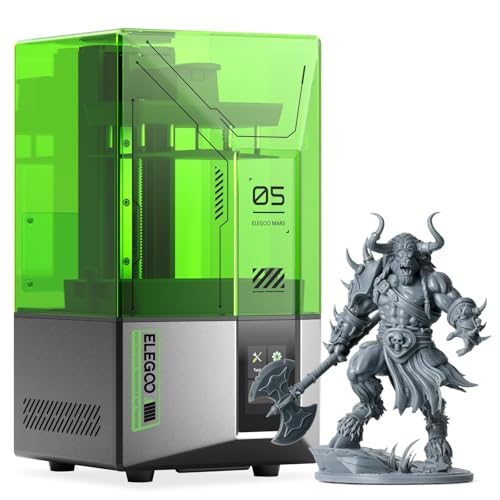
- 4K mono LCD for intricate textures
- One-click automatic leveling
- Smart alerts and self-check features
Best For: Beginners printing detailed desktop models
Beginner's 9K Choice
Creality HALOT-X1 Neo Resin Printer

- 9K LCD with 18μm XY resolution
- Factory pre-leveled platform
- USB, Wi-Fi, and cloud file transfer
Best For: Beginners making miniatures and figurines
Best High-Resolution Pick – Saturn 4 Ultra 16K
For resin printers for detailed models, the ELEGOO Saturn 4 Ultra 16K combines extremely fine XY resolution with a generous build area. Its heated resin tank, automatic leveling, and monitoring features also make it a practical choice for users who want detail without constant manual intervention.
Best For: Large, intricate models and users prioritizing maximum screen resolution.
Pros:
- 16K screen with 14 × 19 μm XY resolution for highly detailed prints
- Automatic resin-tank heating helps maintain a 25°C printing temperature
- AI camera, mechanical sensors, auto-leveling, Wi-Fi transfer, and power-loss resume
- Up to 150 mm/h printing with tilt-release technology
Cons:
- Heavy 35.4-pound printer with a relatively large footprint
- Advanced monitoring and automation may be more than casual users need
This is a strong all-around option when fine surface detail, large models, and automated monitoring matter most. The heated tank is particularly useful where cooler temperatures could reduce resin consistency and print success.
Best Precision Workflow – Reflex RS Turbo
The Reflex RS Turbo is aimed at demanding users who want resin printers for detailed models with a streamlined workflow. Its high-contrast amber screen, precision Z-axis, pre-tuned profiles, and automated model preparation focus on repeatable detail and dimensional accuracy.
Best For: Experienced makers and precision-focused workflows using varied resins.
Pros:
- 566:1 screen contrast supports crisp details and sharp dimensional accuracy
- One-click slicing can repair common model defects and generate supports
- C5 ball-screw Z-axis provides ≤2 μm repeat positioning accuracy
- Force sensors detect residue and can pause prints while generating diagnostics
Cons:
- At 50.6 pounds, it is the heaviest option in this roundup
- Its extensive precision and monitoring systems may have a steeper learning curve
- Some workflow features depend on the printer’s proprietary slicing software
Choose this model when precision control and process diagnostics are more important than simple plug-in-and-print operation. The calibrated screen, advanced motion algorithms, and Z-axis compensation are well suited to detail-oriented production.
Best Smart-Speed Option – Saturn 4 Ultra 16K
This ELEGOO Saturn 4 Ultra 16K is a good fit for resin printers for detailed models when fast output and automated checks are both priorities. It pairs a 16K mono LCD and 14 × 19 μm XY resolution with tilt-release printing, smart sensors, and a heated resin tray.
Best For: Users who want highly detailed prints with fast production and guided setup.
Pros:
- 16K, 15120 × 6230px display delivers fine model detail
- Print speeds reach up to 150 mm/h using tilt-release technology
- Automatic leveling, resin heating, and power-loss resume simplify operation
- AI camera can identify empty build plates and model warping
Cons:
- Its large dimensions require substantial workspace
- The 40.7-pound weight makes repositioning less convenient
This version stands out for combining detailed output with speed-oriented features. It is especially appealing if you regularly print multiple models and want the printer to monitor common failure conditions for you.
Best Resin Flexibility – Photon P1 14K
The ANYCUBIC Photon P1 is a versatile choice among resin printers for detailed models, offering a 14K display, stable ball-screw motion, and a build area suited to larger projects. Its ability to handle resins up to 8,000 cps also gives advanced users more material flexibility.
Best For: Creators who need fine detail and compatibility with high-viscosity or industrial-style resins.
Pros:
- 14K mono LCD and 16.8 × 24.8 μm XY pixel size reproduce fine details
- Stable ball screws and precision rails help minimize vibration
- Factory-calibrated auto-leveling and preconfigured resin settings simplify setup
- Supports resins with viscosity up to 8,000 cps
Cons:
- Its 24.41-inch depth requires a notably deep workspace
- It does not list the higher 16K resolution of the ELEGOO alternatives
The Photon P1 is the practical pick when resin compatibility is as important as detail. Wave Release Technology, AI inspection, and resin-level monitoring further support reliable operation during longer or more demanding jobs.
Fast Detail Specialist – ELEGOO Mars 5 Ultra 9K
For resin printers for detailed models, the ELEGOO Mars 5 Ultra combines a 9K monochrome LCD with 1818μm XY resolution, uniform COB lighting, and a generous build area. Its speed and automated monitoring features also make it practical for makers who want detailed output without constant supervision.
Best For: Detailed miniatures, lifelike models, and users who value fast printing with remote monitoring.
Pros:
- 9K screen and 92% light uniformity support precise, detailed prints.
- Printing speeds reach up to 150mm/h, with fast and slow modes.
- AI camera, mechanical sensing, automatic calibration, and WiFi control add convenience.
- Printing can resume after an interruption.
Cons:
- The printer weighs 24.6 pounds and occupies a substantial amount of space.
- Its advanced monitoring and WiFi features may be more than casual users need.
The Mars 5 Ultra is a strong all-around choice when fine detail, speed, and smart oversight matter equally. Its 9K resolution and automated safeguards make it especially appealing for repeatable model production.
Precision Made Simple – UniFormation GK3T 16K
The UniFormation GK3T is aimed at shoppers seeking resin printers for detailed models without a complicated setup. Its 16K LCD, factory pre-leveling, smart resin handling, and built-in heating system focus on sharp results and stable day-to-day operation.
Best For: Beginners and everyday makers printing intricate miniatures, figurines, and complex prototypes.
Pros:
- 16K resolution and 14×19μm pixel size capture fine surface details.
- Factory pre-leveling, auto feeding, and a quick-release build plate simplify setup.
- Built-in heating supports resin fluidity in temperatures as low as 0°C/32°F.
- App control enables remote monitoring, progress updates, and one-touch start or stop.
Cons:
- At 52.8 pounds, it is considerably heavier than the other listed options.
- The printer’s larger 20.47-inch height may require dedicated workspace.
- Its ecosystem-oriented workflow is most useful when paired with compatible wash and cure equipment.
The GK3T stands out for combining exceptionally fine resolution with beginner-friendly automation. Choose it if stable performance, seasonal temperature support, and an integrated workflow are more important than a compact footprint.
Balanced Detail Value – ANYCUBIC Photon Mono 4
The ANYCUBIC Photon Mono 4 is a straightforward option for resin printers for detailed models, pairing a 10K monochrome LCD with a stable LighTurbo light source. Its practical build volume, simplified leveling, and 70mm/h printing speed suit everyday projects and detailed model work.
Best For: Beginners and hobbyists who want smooth, detailed prints with a manageable setup.
Pros:
- 10K resolution and 17×17μm pixels support fine model detail.
- LighTurbo lighting helps reduce layer lines and rasterization.
- The 6.04×3.42×6.49-inch build volume accommodates a range of projects.
- Laser-engraved platform improves adhesion while keeping model removal manageable.
Cons:
- Its maximum printing speed is 70mm/h, slower than the ELEGOO Mars 5 Ultra.
- The four-point leveling process still requires an initial manual setup.
- Anycubic APP service is not supported.
The Photon Mono 4 offers a useful balance of precision, capacity, and accessible operation. It is a sensible pick for detailed models when you do not need app connectivity or the fastest printing speeds.
Easy-Start Detailer – ELEGOO Mars 5 4K Resin Printer
The ELEGOO Mars 5 is a practical entry point for resin printers for detailed models. Its 4K mono LCD and COB light source are designed to reproduce fine textures, while one-click automatic leveling helps reduce setup friction.
Best For: Beginners and desktop makers who want detailed prints in a compact 5.65 × 3.53 × 5.91-inch build area.
Pros:
- 4K mono LCD with COB light source supports detailed, high-fidelity prints.
- One-click automatic leveling simplifies initial setup.
- Residue detection, resin-shortage alerts, and leveling-failure alarms help reduce waste.
- Self-check and overheat protection add useful operational safeguards.
Cons:
- The build area is more limited than larger-format resin printers.
- Its feature set is focused on straightforward desktop printing rather than oversized projects.
The Mars 5 stands out when ease of use matters as much as detail. Choose it for miniatures and similarly sized models, but look to a larger printer if you need multiple large parts in one job.
Beginner's 9K Choice – Creality HALOT-X1 Neo Resin Printer
For shoppers comparing resin printers for detailed models, the Creality HALOT-X1 Neo combines an 18μm XY resolution with a beginner-friendly setup. Its pre-leveled platform and multiple file-transfer options make it easier to move from model preparation to printing.
Best For: Miniature creators, tabletop gamers, and beginners who want high-resolution printing in a compact desktop format.
Pros:
- 9K LCD and 18μm XY pixel size are suited to fine details in miniatures and figurines.
- Factory pre-leveled platform supports a plug-and-play start.
- Files can be transferred through USB, 2.4GHz Wi-Fi, or Creality Cloud.
- Works with HALOT BOX, CHITUBOX, and Lychee Slicer.
Cons:
- The 153.36 × 77.76 × 160 mm build volume is better suited to compact models than large pieces.
- AI 2D-to-3D generation can take as long as 3.5 hours for a model.
The HALOT-X1 Neo is a strong fit if detail and a low-friction workflow are priorities. Its compact build volume makes it less suitable for large-format projects, but well matched to miniatures and character models.
Large-Format Detail Pro – ELEGOO Jupiter 2 16K Resin Printer
The ELEGOO Jupiter 2 is built for shoppers who need resin printers for detailed models at a much larger scale. Its 16K resolution, 20 × 26μm XY resolution, and 302.4 × 161.98 × 300 mm build volume support detailed prints while accommodating bigger objects or multiple smaller models.
Best For: Experienced makers, prop builders, and production-minded users who need large, detailed resin prints and longer unattended workflows.
Pros:
- Large build volume supports bigger objects or multiple models in one job.
- 16K resolution and a fully enclosed light source are designed for uniform, detailed exposure.
- Automatic resin feeding, smart tank heating, and multi-point auto leveling simplify operation.
- Wi-Fi cluster management, monitoring, and power-loss recovery support extended printing.
Cons:
- At 63.8 pounds and roughly 28 inches wide, it requires substantial space and a sturdy setup.
- The larger format is likely excessive for users printing only small miniatures.
- Its broader feature set may involve more maintenance than a basic desktop printer.
The Jupiter 2 is the most capable choice here for combining scale with fine detail. Its size and weight make it a commitment, but the automated resin handling, heating, monitoring, and large build area can justify that investment for demanding projects.
How We Picked the Best Resin Printers for Detailed Models
We evaluated these printers by looking beyond headline resolution. Our comparison considers LCD or MSLA detail potential, XY resolution, build volume, leveling and resin-handling automation, Z-axis stability, exposure consistency, print speed, software and connectivity features, and practical usability. Features such as heated vats, automatic feeding, cameras, and pre-tuned profiles can improve consistency, but they do not replace correct resin settings, careful support placement, and proper post-processing.
Because projects vary, the list includes compact desktop printers for smaller models, fast mid-size machines, and large-format options for producing multiple parts or oversized pieces in fewer batches.
Quick Comparison
- Highest resolution: 16K models are aimed at extremely fine surface detail and smoother small features.
- Balanced everyday choices: 9K to 14K printers offer a strong mix of detail, speed, and manageable operating costs.
- Compact and accessible: Smaller Mars and Photon models suit beginners, hobbyists, and limited workspaces.
- Larger production capacity: Jupiter and GK3T-class machines provide more room for batches and bigger models.
- Workflow convenience: Auto-leveling, resin heating, cameras, Wi-Fi, and automatic feeding can reduce setup effort.
Key Buying Factors for Resin Printers for Detailed Models
Resolution and Actual Detail
LCD resolution matters, but XY pixel size, optical uniformity, exposure control, and mechanical rigidity matter just as much. A well-calibrated 9K or 14K printer can outperform a poorly tuned higher-resolution machine. Check the printer’s XY resolution and supported layer heights, not only its advertised pixel count.
Build Volume and Model Scale
Choose enough platform space for your largest planned pieces plus supports. A compact printer can be more economical for miniatures, while a larger platform is useful for batch production. Remember that larger vats generally require more resin for each failed print and may need sturdier ventilation arrangements.
Reliability and Automation
Automatic leveling, resin detection, mechanical sensors, heated tanks, and automatic feeding can make printing more repeatable. These features are especially valuable for beginners or anyone running frequent jobs, though they add complexity and may increase the purchase price.
Speed, Materials, and Workflow
Compare advertised speed with real resin profiles and model geometry. Confirm compatibility with the resins you plan to use, including standard, water-washable, tough, or castable formulas. Wi-Fi, cameras, and app controls are convenient, but reliable slicing software and easy access to replacement films and screens are more important over time.
Safety and Post-Processing
Resin printing requires ventilation, gloves, eye protection, washing, and UV curing. Budget for cleaning supplies, a wash-and-cure setup, spare release film, and resin storage. A printer should fit your entire workflow—not just the printing stage.
Who Should Buy Which Resin Printers for Detailed Models?
Beginners and casual hobbyists should prioritize automatic leveling, straightforward software, and a manageable build size. Compact Mars and Photon models can reduce upfront cost and simplify learning.
Miniature and prop detail enthusiasts should focus on a high-resolution 9K, 14K, or 16K screen, precise Z-axis movement, and consistent exposure. Choose the highest practical resolution that fits your budget and resin usage.
Batch printers and small studios benefit from larger platforms, fast profiles, Wi-Fi controls, cameras, and dependable resin management. A larger 16K machine can be worthwhile when producing many parts at once.
Users making oversized models should choose a large-format printer such as a Jupiter-class option, provided they have adequate ventilation, workspace, and budget for larger resin consumption.