The right SSD enclosure can turn an unused internal drive into a fast, portable external SSD for backups, file transfers, gaming libraries, or system recovery.
This roundup compares 10 SSD enclosures across NVMe and SATA compatibility, USB speeds, tool-free installation, durability, and overall value.
Best 10 SSD Enclosures Picks for 2026
Best Value
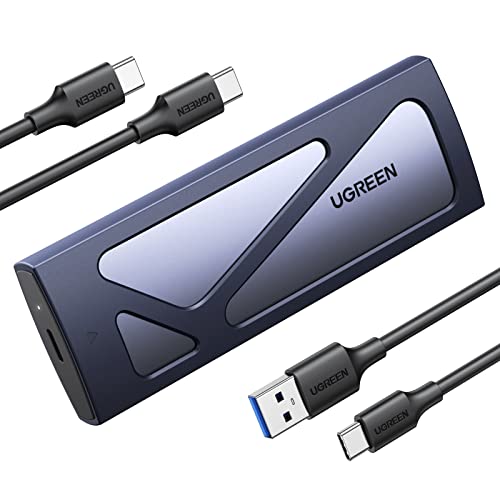
- 10Gbps USB 3.2 Gen 2 performance
- Tool-free support for four M.2 sizes
- Includes cables, case, and thermal pad
Best For: Everyday portable NVMe storage
Most Rugged
ASUS TUF Gaming A2 SSD Enclosure

- Supports NVMe PCIe and SATA M.2 SSDs
- Up to 20Gbps over USB-C 3.2 Gen 2x2
- MIL-STD-810H and IP68-tested design
Best For: Durable gaming and travel storage
Best Silent Design
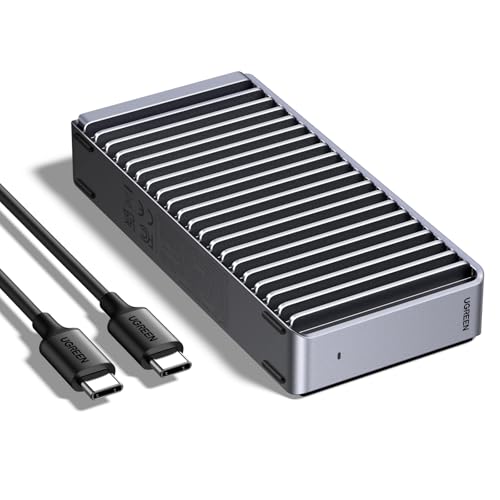
- Up to 3,600MB/s with compatible equipment
- Fanless finned cooling design
- Supports NVMe drives up to 8TB
Best For: Quiet high-speed NVMe storage
Best Budget SATA Pick
Sabrent 2.5-Inch USB 3.0 Enclosure
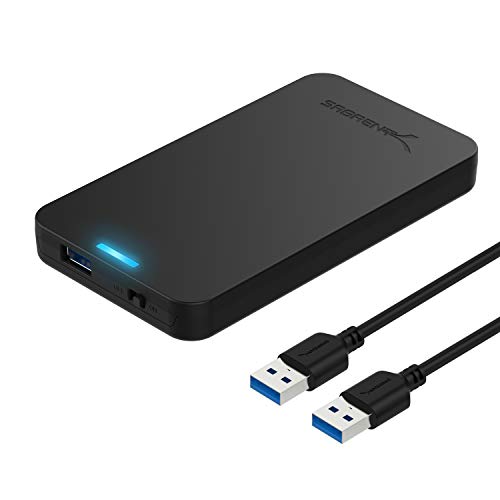
- Tool-free 2.5-inch SATA installation
- USB 3.0 with UASP support
- Compact plastic design
Best For: Converting a 2.5-inch SATA SSD into external storage
Best Premium NVMe Pick
ASUS ROG Strix Arion M.2 Enclosure

- 10 Gbps USB 3.2 Gen 2
- Fits multiple M.2 NVMe sizes
- Aluminum body with thermal pads
Best For: Fast external storage for PCIe NVMe M.2 SSDs
Best Cable-Flexible SATA Pick
BENFEI 2.5-Inch USB-C Enclosure

- USB-C and USB-A connection options
- Tool-free 2.5-inch SATA installation
- UASP support up to 5 Gbps
Best For: Connecting SATA SSDs across USB-C and USB-A devices
Best for Cooling

- Flip-open installation needs no screws or tools
- 10Gbps USB-C with aluminum heat transfer
- Supports 2230–2280 NVMe drives up to at least 8TB
Best For: Extended NVMe transfers, upgrades, and portable tech work
Best for Versatility
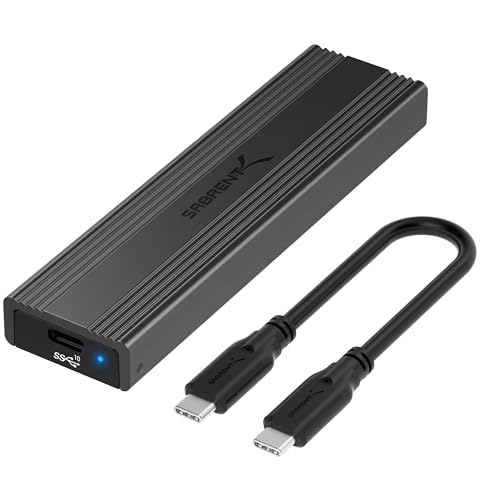
- Supports both M.2 NVMe and SATA drives
- Tool-free installation in a slim aluminum case
- USB-C 10Gbps and thermal pad included
Best For: Portable use with multiple compatible M.2 drive types
Best for Portability
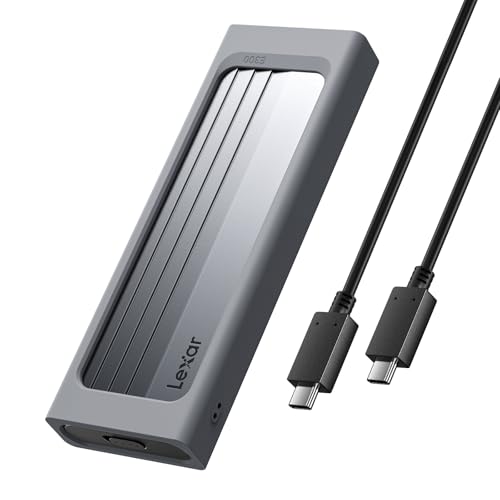
- Tool-free USB-C enclosure for NVMe drives
- Supports 2230–2280 drives up to 4TB
- Aluminum body with thermal pad and shock buffer
Best For: Portable NVMe storage for USB-C computers
Best Value – UGREEN 10Gbps NVMe Enclosure
If you need a straightforward option among SSD enclosures, the UGREEN USB-C M.2 NVMe model combines 10Gbps USB 3.2 Gen 2 performance with tool-free installation. It supports common NVMe M.2 sizes and includes both USB-C and USB-A cables for flexible connectivity.
Best For: Everyday backups, portable storage, and users who want an easy-to-install NVMe enclosure for computers, tablets, or smartphones.
Pros:
- 10Gbps transfer rate with backward compatibility for USB 3.1 and USB 3.0
- Tool-free design supports 2230, 2242, 2260, and 2280 NVMe drives
- Includes silicone protection, thermal pad, and USB-C-to-C and USB-C-to-A cables
- RTL9210 chip provides short-circuit, over-current, UASP, and TRIM support
Cons:
- Does not support SATA NGFF or mSATA SSDs
- Full 10Gbps performance requires a USB-C 3.2 Gen 2 data cable and compatible port
This is a practical, portable choice for NVMe owners who value broad size compatibility and simple installation over the higher speeds of USB4 enclosures.
Fastest Performance – SABRENT USB4 NVMe Enclosure
For demanding transfers, the SABRENT USB4 enclosure is one of the fastest SSD enclosures in this roundup. It can reach up to 3,900MB/s over USB4 and supports Thunderbolt 3, Thunderbolt 4, and USB-C connections, while its integrated fan helps manage heat during extended workloads.
Best For: Creators, editors, and mobile power users transferring large files or working with PCIe Gen4 x4 NVMe SSDs.
Pros:
- Up to 3,900MB/s over USB4 and up to 2,700MB/s with Thunderbolt 3 or 4
- Tool-free installation supports 2230, 2242, 2260, and 2280 PCIe NVMe drives
- Integrated active cooling fan helps maintain performance during large transfers
- Works with Windows and macOS without drivers or external power
Cons:
- Does not support SATA M.2 SSDs
- Its top speed depends on a compatible USB4 host and cable
The SABRENT is the performance-focused pick here, particularly if your computer has USB4 or Thunderbolt and you regularly move large projects.
Most Rugged – ASUS TUF Gaming A2 SSD Enclosure
The ASUS TUF Gaming A2 stands out among SSD enclosures for its rugged construction and dual-protocol support. It accepts both M.2 NVMe PCIe and SATA SSDs, and its USB-C 3.2 Gen 2×2 interface supports speeds up to 20Gbps with a compatible host.
Best For: Gamers and mobile users who want a durable enclosure that can work with either NVMe or SATA M.2 drives.
Pros:
- Supports both M.2 NVMe PCIe and SATA SSDs in 2242, 2260, and 2280 sizes
- USB-C 3.2 Gen 2×2 provides speeds up to 20Gbps
- Silicone-rubber exterior underwent MIL-STD-810H and IP68 testing
- Q-Latch enables screw-free SSD swaps, while the aluminum chassis and thermal pad aid cooling
Cons:
- Maximum speed requires a compatible USB-C 3.2 Gen 2×2 setup
- Heavier than the smaller UGREEN enclosure at 279g
With NVMe and SATA compatibility plus a protective exterior, the TUF Gaming A2 is a versatile option when durability matters as much as transfer speed.
Best Silent Design – UGREEN 40Gbps NVMe Enclosure
The UGREEN 40Gbps model is a high-speed choice among SSD enclosures that uses a finned, fanless cooling design. Its ASM2464PD chip supports transfer rates up to 3,600MB/s, while compatibility with USB4 and Thunderbolt 3 or 4 makes it suitable for fast modern systems.
Best For: Users who want high-speed NVMe storage with quiet, fanless cooling for work, gaming, or video playback.
Pros:
- Up to 3,600MB/s with compatible USB4 or Thunderbolt 4 equipment
- Fanless double-sided fin design provides quiet heat dissipation
- Supports 2230, 2242, 2260, and 2280 NVMe drives up to 8TB
- Compatible with USB4, USB 3.2, USB 3.1, USB 3.0, USB 2.0, and Thunderbolt 3/4
Cons:
- Does not support SATA NGFF or mSATA SSDs
- Achieving 3,600MB/s requires compatible Thunderbolt 4 cables and devices
- Some thicker SSDs may require a thinner thermal pad
This enclosure makes sense for NVMe users who prioritize quiet operation and strong cooling, provided their host system and cable can support its highest speeds.
Best Budget SATA Pick – Sabrent 2.5-Inch USB 3.0 Enclosure
For shoppers comparing ssd enclosures for a standard 2.5-inch SATA drive, the Sabrent EC-UASP offers a straightforward, tool-free setup and USB 3.0 connectivity. It supports UASP SATA III and works with USB 2.0 and 1.1 ports when needed.
Best For: Users converting a 2.5-inch SATA SSD or notebook hard drive into a portable external drive.
Pros:
- Tool-free, plug-and-play installation with no drivers required.
- USB 3.0 supports transfer rates up to 5 Gbps; USB 2.0 supports up to 480 Mbps.
- Supports UASP SATA III and is hot-swappable.
- Compatible with Windows and Mac systems listed by the manufacturer.
Cons:
- Limited to 2.5-inch SATA drives rather than M.2 NVMe SSDs.
- The plastic enclosure may offer less premium durability than aluminum alternatives.
The Sabrent is a practical, compact choice for basic SATA SSD upgrades, drive reuse, and file transfers. Its main limitation is compatibility: confirm that your drive is a 2.5-inch SATA model before buying.
Best Premium NVMe Pick – ASUS ROG Strix Arion M.2 Enclosure
The ASUS ROG Strix Arion is a premium option among ssd enclosures for PCIe NVMe M.2 drives. Its aluminum alloy body, USB 3.2 Gen 2 Type-C connection, and included USB-C and USB-C-to-A cables support fast, flexible external storage.
Best For: NVMe SSD owners who want a durable aluminum enclosure with up to 10 Gbps connectivity and ROG styling.
Pros:
- Supports M.2 PCIe NVMe SSDs in 2230, 2242, 2260, and 2280 sizes.
- USB 3.2 Gen 2 supports transfer speeds up to 10 Gbps.
- Aluminum alloy construction and thermal pads help draw heat away from the drive.
- Includes both USB-C and USB-C-to-A cables, plus Aura Sync RGB lighting.
Cons:
- M.2 NVMe SSD is not included.
- Not designed for 2.5-inch SATA drives.
- Its ROG features may be unnecessary for users seeking a basic enclosure.
The Strix Arion stands out when drive format, speed, cooling, and design all matter. It is a strong match for compatible NVMe hardware, but buyers should verify the SSD is PCIe NVMe rather than SATA M.2.
Best Cable-Flexible SATA Pick – BENFEI 2.5-Inch USB-C Enclosure
The BENFEI 2.5-inch enclosure is a versatile choice for shoppers comparing ssd enclosures with broad connection support. It accepts 2.5-inch SATA I, II, and III drives, includes Type-C and Type-A connectivity, and uses a tool-free, plug-and-play design.
Best For: Users who need to connect a 2.5-inch SATA SSD to newer USB-C devices or traditional USB-A computers.
Pros:
- USB Type-C/Type-A design supports flexible connections to computers and other compatible devices.
- Tool-free installation, hot-swapping, and no-driver setup simplify use.
- Supports UASP SATA III and transfer rates up to 5 Gbps.
- Works with Windows, Linux, and MacOS 8.0 and above according to the supplied specifications.
Cons:
- Designed for 2.5-inch SATA drives, not M.2 NVMe SSDs.
- Drive compatibility is specified for 7/9.5 mm thickness and capacities up to 6 TB.
BENFEI’s enclosure is a convenient middle ground for mixed-device households because of its Type-C and Type-A connection options. It is especially useful for reusing older 2.5-inch SATA SSDs, provided the drive fits the stated thickness and capacity limits.
Best for Cooling – Tool-Free NVMe Enclosure
For shoppers comparing ssd enclosures for demanding portable work, the SABRENT EC-PNVO combines a flip-open, tool-free design with USB 3.2 Gen 2 connectivity. Its aluminum top and thermal pad are designed to help manage heat during longer transfers, but it supports NVMe drives only.
Best For: NVMe SSD upgrades, cloning, troubleshooting, and extended transfers where cooling and quick installation matter.
Pros:
- Tool-free flip-open installation for M.2 NVMe drives.
- Supports 2230, 2242, 2260, and 2280 sizes up to at least 8TB.
- USB-C 10Gbps connectivity with aluminum cooling and no external power.
- Works with computers, gaming handhelds, consoles, phones, and tablets listed by the manufacturer.
Cons:
- Does not support M.2 SATA SSDs.
- Includes one drive slot only.
The EC-PNVO is a strong fit if you already have an NVMe drive and want fast, tool-free access in a compact enclosure. Choose another model if SATA compatibility is important.
Best for Versatility – NVMe and SATA M.2 Enclosure
The SABRENT EC-SNVE stands out among ssd enclosures because it accepts both M.2 NVMe and M.2 SATA drives. It offers tool-free installation, USB 3.2 Type-C speeds up to 10Gbps, and a slim aluminum body, though it is an enclosure only and has no clearance for pre-installed heatsinks.
Best For: Users who need one portable case for compatible M.2 NVMe and SATA SSDs.
Pros:
- Supports M.2 NVMe and SATA SSDs in 2242, 2260, and 2280 sizes.
- Tool-free drive installation and removal.
- USB 3.2 Type-C supports up to 10Gbps and is backward compatible.
- Includes a thermal pad, Type-C cable, and slim aluminum housing.
Cons:
- SSD is not included.
- Does not support 2.5-inch SATA or mSATA drives.
- Cannot accommodate drives with pre-installed heatsinks.
This is the most flexible choice of the three for mixed M.2 collections. Its broad protocol support is useful, but confirm your drive length and remove any attached heatsink before installation.
Best for Portability – Lexar E300 NVMe Enclosure
The Lexar E300 is a compact option for shoppers seeking ssd enclosures with simple setup and portable protection. It supports M.2 NVMe drives across four common lengths, adds an aluminum casing and thermal pad, and connects over USB-C at up to 10Gbps.
Best For: Carrying a compatible NVMe SSD between USB-C-equipped computers and creating portable external storage.
Pros:
- Tool-free installation for quick drive conversion.
- Supports M Key and B+M Key NVMe drives in 2230, 2242, 2260, and 2280 sizes.
- Aluminum casing and thermal pad help with heat dissipation.
- Lanyard hole and shock-absorbing structure support on-the-go use.
Cons:
- Does not support SATA SSDs.
- Maximum supported capacity is 4TB.
- Compatibility is specified for devices with a USB-C interface.
The E300 makes sense for a portable NVMe setup where easy installation and physical protection are priorities. Its 4TB limit and lack of SATA support are the main restrictions to check before buying.
How We Picked the Best SSD Enclosures
We selected these SSD Enclosures to cover the main storage formats and use cases, from compact M.2 NVMe drives to familiar 2.5-inch SATA SSDs and hard drives. We considered interface speed, drive compatibility, installation method, included cables, cooling design, portability, and the type of computer each enclosure suits best.
Performance claims depend on the installed SSD, host port, cable, operating system, and file-transfer workload. A 40Gbps or USB4 enclosure can be substantially faster than a 10Gbps model, but only when the computer and drive support those speeds.
Quick Comparison
| Best For | Recommended Type | What to Look For |
|---|---|---|
| Everyday NVMe upgrades | USB-C 10Gbps M.2 enclosure | Tool-free installation and thermal control |
| Maximum transfer speed | USB4 or 40Gbps NVMe enclosure | Compatible USB4/Thunderbolt-class host port |
| Gaming and rugged use | Reinforced NVMe enclosure | Strong shell, heat management, and secure fit |
| Older 2.5-inch drives | SATA-to-USB enclosure | 2.5-inch support and USB 3.x connectivity |
| Mixed M.2 storage | NVMe/SATA-compatible enclosure | Explicit support for both protocols |
Key Buying Factors for SSD Enclosures
Drive Compatibility
Confirm the enclosure matches your SSD before buying. M.2 drives can use NVMe over PCIe or SATA, and those protocols are not automatically interchangeable. Also check the supported physical length, such as 2230, 2242, 2260, or 2280. A 2.5-inch SATA enclosure is designed for a different drive format and cannot accept an M.2 SSD without an adapter.
USB Speed and Port Compatibility
USB 3.2 Gen 2 enclosures generally target up to 10Gbps, while USB 3.2 Gen 2×2, USB4, and 40Gbps models can offer higher throughput. Your computer must have a matching high-speed port, and the cable must support the advertised standard. For normal backups and media storage, 10Gbps is often the best balance of cost and performance.
Thermals and Installation
Fast NVMe drives generate heat during sustained transfers. Look for an aluminum body, thermal pad, heatsink, or other cooling provision if you frequently move large video files or game libraries. Tool-free designs are convenient, while screw-secured enclosures may provide a firmer long-term fit.
Cables and Portability
USB-C-to-C and USB-C-to-A cables improve compatibility across newer laptops and older desktops. A compact, bus-powered enclosure is convenient for travel, but check that its connector and drive retention system are sturdy enough for regular use.
Who Should Buy Which SSD Enclosures?
Choose a 10Gbps NVMe enclosure for everyday upgrades, portable work files, and routine backups. Pick a USB4 or 40Gbps model if you regularly transfer large projects and already own a compatible high-speed computer. Gamers and frequent travelers should prioritize durable construction and effective heat dissipation.
For a spare laptop drive, older SSD, or 2.5-inch hard disk, a SATA-to-USB enclosure is the practical choice. If you own both NVMe and SATA M.2 drives, select a model that explicitly supports both protocols rather than assuming every M.2 enclosure is universal.