Transporting a sewing machine is much easier with a rolling case that fits securely, stores essential accessories, and moves smoothly across the surfaces you use most.
These 10 options cover detachable dollies, padded bases, multiple pockets, universal designs, and heavy-duty wheels, helping you find a practical match for your machine and sewing routine.
Best 10 Sewing Machine Rolling Cases Picks for 2026
Best Organized Pick
LUXJA Rolling Sewing Machine Case

- Padded polyester construction with removable bottom insert
- 11 compartments plus extensive exterior storage
- Detachable dolly, shoulder strap, and telescoping handle
Best For: Sewists who carry many accessories
Best Compact Trolley

- Padded heavy-duty nylon construction
- Removable bottom pad and detachable dolly
- Front and side pockets for sewing essentials
Best For: Simple transport between home and sewing classes
Best Protective Structure

- Front and back hard boards plus fastening straps
- Water-resistant nylon and removable bottom pad
- Four wheels with multiple carrying options
Best For: Transporting a machine with added structural support
Best Tool Organization

- 29 small pockets for detailed tool storage
- 360-degree universal wheels and 41.5-inch trolley
- Padded nylon body with PE hard-board base
Best For: Sewists carrying many small tools and notions
Best All-Around Storage
Detachable Rolling Sewing Machine Case

- Folding four-wheel trolley
- Ten organized compartments and pockets
- Reinforced nylon with rigid base
Best For: Organized transport to classes, gatherings, and trips
Best for Flexible Carrying
Arcoyard Rolling Sewing Machine Case

- Removable hard support pad
- Ten pockets plus two clear pockets
- Roll, tote, or attach to luggage
Best For: Travelers who switch between rolling and hand-carrying
Best for Machine Protection
Amythe 5-Wheel Sewing Machine Bag

- 900D padded Oxford fabric
- Three securing straps
- Detachable five-wheel base
Best For: Frequent transport to classes, workshops, and craft events
Best Overall
Universal Sewing Machine Rolling Case

- Hard base supports and protects the machine
- Fits many standard Singer and Brother models
- Pockets and spool holders organize accessories
Best For: Everyday transport to classes, meetups, and craft events
Best for Travel
Detachable Rolling Sewing Machine Case

- Removable hard base adds flexible support
- Two wheels and shoulder strap ease transport
- Six pockets plus spool holders organize supplies
Best For: Classes, holidays, and travel with a standard-size machine
Best for Large Machines
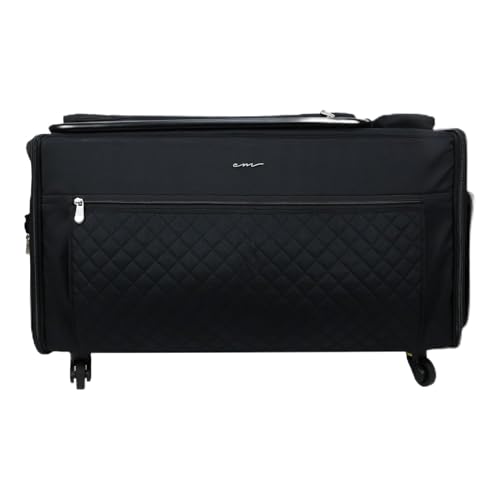
- Five wheels support stable, smooth movement
- Large interior fits machines and project supplies
- Top-loading design provides quick access
Best For: Oversized machines, full kits, fabric, and bulky accessories
Best Organized Pick – LUXJA Rolling Sewing Machine Case
The LUXJA rolling sewing machine case is a practical choice when you want substantial accessory storage alongside padded machine protection. Its wide-open interior, detachable dolly, and numerous pockets make it convenient for classes, travel, or home-to-studio transport.
Best For: Sewists who prioritize organized storage and multiple carrying options.
Pros:
- Heavy-duty polyester with thick padding and a removable padded bottom insert.
- Extensive organization, including 11 compartments, elastic loops, pouches, mesh pockets, and exterior zipper pockets.
- Includes a detachable dolly, shoulder strap, handles, and an extendable telescoping handle.
Cons:
- Bag size is limited to 16.25 x 7.75 x 13 inches, so machine dimensions should be checked carefully.
- The detachable dolly adds a setup step when changing carrying modes.
With strong padding and especially generous organization, this is one of the more versatile sewing machine rolling cases for users carrying plenty of notions and supplies.
Best Compact Trolley – LUXJA Sewing Machine Case
This LUXJA sewing machine case combines a padded nylon interior with a detachable dolly for easier transport. The wide opening simplifies loading, while the front and side pockets provide room for common sewing essentials without an overly complex layout.
Best For: Sewists seeking a straightforward rolling case with removable trolley support.
Pros:
- Heavy-duty nylon and thick padding help keep the machine secure.
- Removable bottom pad helps reduce bumping during transport.
- Front and side pockets accommodate a foot pedal, power cable, manuals, fabric, and small accessories.
Cons:
- The inner dimensions are 16.5 x 7.5 x 11 inches, so compatibility depends on the machine’s exact size.
- The dolly must be installed according to the provided guidance.
This model offers a useful balance of protection, basic organization, and portability, especially for users who prefer a removable rolling base.
Best Protective Structure – Rolling Sewing Machine Case
This rolling sewing machine case emphasizes structural protection with extra hard boards on the front and back, fastening straps, and a removable bottom pad. Its water-resistant nylon exterior and four-wheel trolley make it a practical option for transporting a machine and supplies.
Best For: Sewists who want added exterior structure and roomy accessory storage.
Pros:
- Hard boards, fastening straps, and removable bottom padding help protect the machine during carrying.
- Water-resistant nylon exterior is designed to be easy to clean.
- Four wheels, padded removable shoulder strap, sturdy handles, and adjustable trolley handle offer flexible transport.
Cons:
- Its inner dimensions are 15.8 x 8.5 x 12 inches, so larger machines may not fit.
- The listing identifies this as a bag-only product, so the machine is not included.
For buyers focused on reinforced construction rather than decorative styling, this case stands out among sewing machine rolling cases for its hard-board panels and secure interior design.
Best Tool Organization – Rolling Sewing Machine Bag
This rolling sewing machine bag is designed for sewists who carry a large collection of small tools. It pairs a padded nylon interior and PE hard-board base with 360-degree universal wheels, YKK zippers, and 29 small tool pockets for detailed organization.
Best For: Sewists who need extensive compartmentalization and smooth multidirectional rolling.
Pros:
- 29 small tool pockets help organize presser feet, needles, tape measures, scissors, and pens.
- Silent universal wheels rotate 360 degrees, and the trolley extends to 41.5 inches.
- Pearl-cotton padding, a PE hard-board bottom, and YKK zippers add practical durability features.
Cons:
- At 4.04 kg, it is relatively heavy before adding a sewing machine and accessories.
- The 19 x 11 x 13-inch outer size may be bulkier than more compact cases.
- The trolley requires five steps to connect securely to the bag.
Its generous dimensions and highly divided interior make this a strong choice when tool organization matters as much as machine transport.
Best All-Around Storage – Detachable Rolling Sewing Machine Case
For shoppers comparing sewing machine rolling cases, this option combines a spacious main compartment with a folding trolley and several dedicated pockets. It is designed for standard-sized machines from brands such as SINGER, Brother, and Janome, while the removable shoulder strap adds carrying flexibility.
Best For: Sewists who want organized storage and multiple ways to carry their machine to classes, gatherings, or trips.
Pros:
- Includes a retractable folding trolley with four double-spinner wheels.
- Ten compartments and pockets accommodate supplies, cords, a foot control, cutting mat, scissors, and even a 16-inch laptop.
- Reinforced nylon, thickened side walls, and a rigid base panel provide added structure and protection.
- Removable shoulder strap and foldable design support both carrying and compact storage.
Cons:
- Compatibility is described for most standard-sized machines, so dimensions should be checked before purchase.
- The listed bag size may be more than needed for shoppers carrying only a machine and minimal accessories.
Its combination of trolley mobility, water-resistant nylon construction, and well-organized storage makes this a practical general-purpose choice for sewing on the go.
Best for Flexible Carrying – Arcoyard Rolling Sewing Machine Case
Among sewing machine rolling cases, the Arcoyard stands out for its combination of protective structure, storage organization, and flexible carrying options. Its securing strap and removable hard bottom pad help stabilize the machine, while the luggage strap makes it easier to pair with a suitcase.
Best For: Sewists who need a rolling case that can also be carried as a tote or attached to luggage.
Pros:
- Thickened nylon fabric, a built-in securing strap, and a removable hard support pad improve stability.
- Ten built-in pockets plus two transparent pockets help organize sewing tools and accessories.
- Offers rolling, top-handle, and suitcase-strap carrying options.
- Includes a water-resistant, stain-resistant compartment for items such as pedals or engine oil.
Cons:
- Its two in-line skate wheels may provide less maneuverability than spinner-wheel designs.
- The large listed dimensions make checking available storage space especially important.
- Although compatible with many listed Brother, Singer, and Janome models, fit still depends on machine dimensions.
With no assembly required and several ways to transport it, this Arcoyard case is a versatile choice for sewing classes, travel, and organized accessory storage.
Best for Machine Protection – Amythe 5-Wheel Sewing Machine Bag
If protection is a priority when comparing sewing machine rolling cases, the Amythe model pairs 900D Oxford fabric with water-resistant coating, thick padding, and three securing straps. Its detachable five-wheel base and telescoping handle are intended to make transport easier without permanently attaching the trolley.
Best For: Sewists who want padded protection, extensive organization, and a detachable rolling base for classes or workshops.
Pros:
- Durable 900D Oxford fabric, water-resistant coating, and thick padding help guard against moisture and bumps.
- Three securing straps help keep the sewing machine in place during transport.
- Detachable five-wheel base and telescoping handle support rolling or carrying.
- Multiple mesh and clear PVC pockets organize thread, bobbins, cords, scissors, and tools.
Cons:
- The case weighs 5.3 pounds before adding the sewing machine and supplies.
- It fits machines up to 16.5 x 9.1 x 11.8 inches, so measuring your machine is important.
- Its soft-shell construction may offer less rigidity than a hard case.
The Amythe is a strong fit for frequent transport, especially when padding, machine restraints, and easy-access organization matter more than minimizing case weight.
Best Overall – Universal Sewing Machine Rolling Case
This universal sewing machine rolling case is a practical choice for transporting most standard Singer, Brother, and Janome machines. Its hard base, 600D Oxford construction, shoulder strap, and multiple storage areas make it useful for classes, craft meetups, and travel.
Best For: Sewists who want a lightweight rolling tote with machine protection and organized accessory storage.
Pros:
- Hard base and durable 600D Oxford material add protection and structure.
- Fits machines up to 17.3 x 7.5 x 12.6 inches, including many standard Singer and Brother models.
- Includes thread spool holders, custom pockets, three compartments, and a shoulder strap.
Cons:
- Compatibility is limited to machines within the listed size range.
- At 6 pounds, it may feel heavier than a basic soft carry bag.
Choose this model if you want a balanced combination of rolling convenience, structured protection, and storage without moving up to an oversized case.
Best for Travel – Detachable Rolling Sewing Machine Case
For sewing machine rolling cases designed around portability, this two-wheel trolley offers a convenient setup for classes, meetups, holidays, and air travel. The removable wooden base, padded sides, accessory pockets, and detachable shoulder strap give it flexibility when rolling is not practical.
Best For: Travelers who need a rolling case with removable support, carry options, and substantial accessory organization.
Pros:
- Two wheels and a lightweight aluminum frame provide smooth rolling.
- Removable hard base and padded sidewalls help protect the machine.
- Six custom pockets, spool holders, and see-through pockets provide organized storage.
- Fits machines up to 17 x 10.2 x 13.3 inches and is described as carry-on sized for most international flights.
Cons:
- Its two-wheel design may be less stable than a multi-wheel case when heavily loaded.
- Actual airline carry-on acceptance can vary by carrier and packing configuration.
This is a strong travel-oriented option when you value multiple carrying methods and removable structure, along with the reassurance of a stated two-year quality warranty.
Best for Large Machines – Jumbo Five-Wheel Sewing Tote
This jumbo sewing machine rolling case is built for sewists who need considerably more room than a standard machine bag provides. Its five heavy-duty wheels, top-loading design, and large interior can accommodate many standard or oversized machines plus fabric, tools, and other supplies.
Best For: Sewists transporting large machines, full project kits, or bulky fabric and accessories.
Pros:
- Five heavy-duty wheels are designed for stable, smooth rolling.
- Large 28 x 14 x 14.5-inch interior leaves room for machines and supplies.
- Top-loading access simplifies packing, setup, and cleanup.
- Retractable and side handles provide additional handling options.
Cons:
- Its 31 x 14.25 x 19-inch exterior is substantially larger than a standard rolling case.
- The 8.03-kilogram weight may be cumbersome when carrying it without rolling.
- Only one compartment is listed, so internal organization may be less segmented.
Pick this case when capacity and rolling stability matter more than compactness. Its oversized format is especially useful for longer sewing sessions or transporting complete project setups.
How We Picked These Sewing Machine Rolling Cases
We focused on features that matter when carrying a sewing machine between rooms, classes, craft groups, and vehicles. Our comparison considers machine compatibility, internal support, wheel design, handle and strap options, storage capacity, materials, and overall portability. Because sewing machines vary considerably in size and weight, a case that works well for one model may be unsuitable for another, so fit remains the most important consideration.
Quick Comparison
Use the individual product details above to compare each case’s dimensions, wheel configuration, padding, storage layout, and carrying options. Detachable-dolly models can be useful when you want to lift the bag separately, while integrated rolling cases may be simpler for frequent transport. Designs with removable bottom boards or padding can offer extra structure, but they may add weight when carried without wheels.
Key Buying Factors
Machine Fit and Interior Protection
Measure your machine’s width, depth, and height—including handles, thread stands, or detachable accessories—before ordering. Allow enough room for light padding without letting the machine shift during movement. A reinforced or padded base is especially helpful because it supports the machine’s weight and protects it from bumps.
Wheels, Stability, and Maneuverability
Check whether the case uses two wheels, multiple wheels, or a five-wheel arrangement. Larger or heavier machines generally benefit from a stable base and wheels that roll smoothly over the surfaces you commonly use. Consider how easily the case turns, whether it remains upright, and how much clearance the wheels provide.
Storage and Carrying Options
Multiple exterior pockets are useful for thread, rulers, pedals, fabric, and sewing tools. Confirm that the pedal and power cord have dedicated space or can be packed without pressing against the machine. Telescoping handles, shoulder straps, and reinforced carry handles provide flexibility, particularly when stairs or tight spaces make rolling impractical.
Construction and Maintenance
Look for durable fabric, secure zippers, reinforced seams, and a base that resists sagging. Removable padding or a detachable trolley can make cleaning and storage easier. A darker or quilted exterior may also help conceal everyday marks, though no soft-sided case should be treated as fully waterproof or impact-proof.
Who Should Buy Which Sewing Machine Rolling Cases?
Choose a compact universal case if you need occasional transport and your machine falls within standard size ranges. A model with abundant pockets suits sewists who carry tools and supplies alongside the machine. For frequent classes or travel, prioritize smooth wheels, a telescoping handle, strong structure, and comfortable lifting points. If your machine is large or heavy, select a case explicitly compatible with its dimensions and favor a reinforced base over maximum pocket capacity. Buyers who regularly navigate stairs may prefer a detachable dolly or a lighter bag that can be carried separately.