Moving 4K video, photo libraries, game installations, and project archives requires more than a basic drive case. The right enclosure can deliver faster sustained transfers, better heat control, and dependable compatibility with your computer and SSD.
We selected 10 options ranging from compact 40Gbps NVMe enclosures to multi-bay storage units. Use the guide below to match interface speed, drive format, cooling, capacity, and portability to the way you handle large files.
Best 10 SSD Enclosures for Large Files Picks for 2026
Best for Active Cooling
40Gbps NVMe Enclosure with Fan

- 40Gbps performance for large file transfers
- Switch-activated fan helps manage heat
- Supports NVMe sizes 2230 through 2280
Best For: Video editors and professionals handling sustained transfers
Best for Maximum Drive Capacity

- Holds five 2.5-inch or 3.5-inch SATA drives
- Supports up to 110TB total capacity
- Includes aluminum cooling and an 80mm fan
Best For: Desktop archives, backups, and multi-drive storage
Best for Quiet High-Speed Transfers
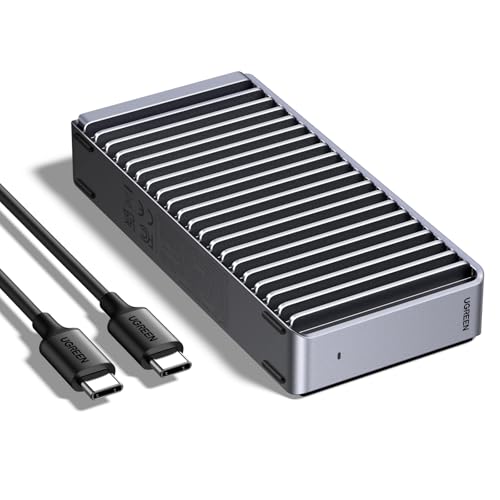
- Up to 3600MB/s with compatible Thunderbolt 4 equipment
- Fanless fin design for quiet cooling
- Supports NVMe drives up to 8TB
Best For: Quiet portable storage on USB4 and Thunderbolt systems
Best USB-C Multi-Drive Value
- Five bays support 2.5-inch and 3.5-inch drives
- Up to 110TB total supported capacity
- USB-C connectivity with active cooling
Best For: Desktop SATA storage expansion and archives
Top Speed Pick
Satechi USB4 NVMe Pro Enclosure

- USB4 connectivity with up to 40Gbps transfer rates
- Supports single-sided M.2 NVMe drives up to 16TB
- Includes thermal pad and tool-free installation pin
Best For: High-speed transfers with compatible NVMe hardware
Best Compatibility Value
SABRENT Tool-Free M.2 Enclosure
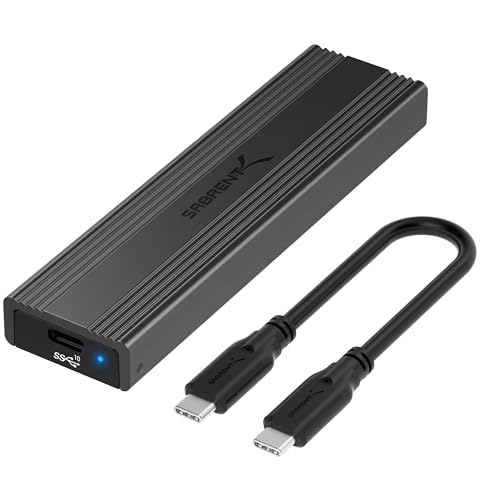
- Accepts both M.2 NVMe and SATA SSDs
- Tool-free installation with no external power
- USB 3.2 Type-C supports up to 10Gbps
Best For: Flexible everyday use with bare M.2 drives
Best Multi-Drive Option
ORICO 40Gbps Four-Bay NVMe Dock

- Holds four M.2 NVMe SSDs with up to 32TB total
- USB4 interface offers up to 40Gbps bandwidth
- Built-in fan and aluminum housing aid cooling
Best For: High-capacity editing and professional media workflows
Best Overall
UGREEN 20Gbps M.2 NVMe Enclosure

- Supports NVMe and SATA M.2 SSDs up to 8TB
- USB 3.2 Gen 2x2 delivers up to 20Gbps
- Aluminum case and thermal pad aid cooling
Best For: Versatile large-file transfers across many devices
Fastest Pick
ORICO USB4 40Gbps NVMe Enclosure

- USB4 supports transfer rates up to 40Gbps
- Designed for M.2 NVMe drives up to 8TB
- Finned aluminum shell improves heat dissipation
Best For: High-speed NVMe transfers on USB4 systems
Best Value
SSK 10Gbps NVMe/SATA Enclosure

- Supports selected NVMe and SATA M.2 SSDs
- Includes USB-C and USB-A cables
- Bus-powered aluminum enclosure with thermal pads
Best For: Everyday large-file transfers at 10Gbps
Best for Active Cooling – 40Gbps NVMe Enclosure with Fan
For demanding transfers, this ACASIS enclosure is one of the more specialized ssd enclosures for large files. Its 40Gbps connection, built-in fan, and aluminum construction are aimed at sustained workloads such as 4K/8K video transfers, backups, and system cloning.
Best For: Video editors, photographers, and professionals moving large files between Mac, Windows, and Linux devices.
Pros:
- 40Gbps connectivity with tested read/write speeds up to 2805/2734 MB/s using a Samsung 980 Pro on a MacBook.
- Switch-activated cooling fan and aluminum heat dissipation help limit thermal throttling during heavy workloads.
- Supports M.2 NVMe drives in 2230, 2242, 2260, and 2280 sizes, with capacity support up to 8TB.
- Works across Thunderbolt 5/4/3, USB4, USB 3.2, USB 3.1, and USB 3.0, with compatible Mac, Windows, and Linux systems.
Cons:
- The fan must be activated with its switch, so cooling is not entirely automatic.
- It accepts NVMe M.2 drives only, not SATA or mSATA SSDs.
- Achieving peak performance depends on a compatible host, drive, and cable.
This is a strong choice when sustained speed and heat management matter more than the simplest plug-and-play design. Its broad compatibility and compact aluminum body also suit mobile professional workflows.
Best for Maximum Drive Capacity – 5-Bay USB 3.0 DAS Enclosure
If your priority is storing large archives rather than reaching NVMe speeds, this Yottamaster is a practical alternative among ssd enclosures for large files. It holds up to five removable SATA drives and provides a substantial desktop storage expansion system.
Best For: Home and office users managing video libraries, digital imaging projects, backups, and long-term archives.
Pros:
- Five bays support 2.5-inch and 3.5-inch SATA HDDs or SSDs, with up to 22TB per drive and 110TB total supported capacity.
- Removable trays and a push-style front door simplify drive installation and replacement.
- Aluminum construction, cooling openings, and an 80mm temperature-controlled fan help manage drive heat.
- Compatible with most Windows, Mac, and Linux systems through USB 3.0.
Cons:
- USB 3.0 and SATA III limit transfer performance compared with 40Gbps NVMe enclosures.
- This is a non-RAID model; hardware RAID is not supported.
- New drives may need formatting and partitioning before use.
The PS500U3 makes more sense as a high-capacity direct-attached storage cabinet than as a speed-focused SSD enclosure. It is especially useful when you want several individual SATA drives accessible from one desktop setup.
Best for Quiet High-Speed Transfers – 40Gbps M.2 NVMe Enclosure
This UGREEN enclosure targets users who need fast, portable storage for large files without a fan. Its ASM2464PD chip, USB4 compatibility, and fin-based cooling design make it a compact option for transferring work, gaming, and video files.
Best For: Users with USB4 or Thunderbolt 4 systems who want a quiet external NVMe drive for travel and high-speed file work.
Pros:
- Reaches up to 3600MB/s with compatible Thunderbolt 4 cables and devices.
- Double-sided fins and three-dimensional cooling provide passive heat dissipation without fan noise.
- Supports 2230, 2242, 2260, and 2280 NVMe drives up to 8TB.
- Includes a USB-C cable, cooling pad, and disassembly kit, and works with Windows, Mac, Linux, and Android systems.
Cons:
- It does not support SATA NGFF or mSATA solid-state drives.
- The advertised 3600MB/s speed requires compatible Thunderbolt 4 equipment and cabling.
- Some thicker SSDs may require thinner thermal pads to fit properly.
For quiet operation and portable 40Gbps performance, this is a compelling NVMe-only enclosure. Verify your host ports, cable, and SSD thickness before buying to get the intended results.
Best USB-C Multi-Drive Value – 5-Bay SATA Enclosure
For users who need several SATA drives connected through USB-C, this Yottamaster provides a spacious desktop solution for ssd enclosures for large files. Its five bays, 110TB maximum capacity, and included cooling fan are designed for storage expansion rather than top-end NVMe throughput.
Best For: Windows and Mac users building a non-RAID desktop storage pool for editing projects, backups, archives, and media libraries.
Pros:
- Supports five 2.5-inch or 3.5-inch SATA HDDs or SSDs, with up to 22TB per drive and 110TB total.
- USB 3.1 Gen 1 Type-C provides up to 5Gbps connectivity, with claimed SSD read/write speeds up to 260MB/s.
- Removable trays, a push-latch front door, and included screws simplify drive installation.
- Aluminum construction and a low-noise 80mm fan help circulate air around the drives.
Cons:
- It does not provide hardware RAID; software RAID is the available option.
- Its 5Gbps interface is much slower than a 40Gbps NVMe enclosure for single-drive transfers.
- Total drive power consumption must remain within the 78W adapter limit.
This model is a sensible fit when capacity and multiple-drive access are more important than maximum transfer speed. Its USB-C connection and broad SATA support make it convenient for a workstation or home archive.
Top Speed Pick – Satechi USB4 NVMe Pro Enclosure
For shoppers comparing ssd enclosures for large files, the Satechi USB4 NVMe SSD Pro Enclosure stands out with USB4 connectivity, support for PCIe Gen 4×4 drives, and advertised transfer rates up to 40Gbps. Its compact design and included thermal pad make it suited to demanding file transfers on the go.
Best For: Users moving large video, project, or backup files with a compatible single-sided M.2 NVMe SSD.
Pros:
- USB4 supports transfer rates up to 40Gbps.
- Supports M.2 sizes 2230, 2242, 2260, and 2280, with capacity up to 16TB.
- Tool-free installation includes a silicone pin and thermal pad.
- Works with Mac, Windows, and Linux systems.
Cons:
- SSD is not included.
- Supports single-sided M.2 NVMe SSDs only; double-sided drives are not supported.
- USB4 speeds require a compatible host device and drive.
This is a strong choice when maximum throughput matters, but buyers should verify their SSD format and host compatibility before purchasing. The included case, cable, thermal pad, and two-year limited warranty add useful value.
Best Compatibility Value – SABRENT Tool-Free M.2 Enclosure
The SABRENT EC-SNVE is a practical option for ssd enclosures for large files when flexibility matters more than USB4 speeds. It accepts both M.2 NVMe and M.2 SATA SSDs, uses a tool-free installation design, and connects over USB 3.2 Type-C at up to 10Gbps.
Best For: Users who want one compact enclosure for compatible M.2 NVMe or SATA drives.
Pros:
- Supports M.2 NVMe and SATA drives in 2242, 2260, and 2280 lengths.
- Tool-free installation requires no screwdriver.
- USB 3.2 Type-C offers up to 10Gbps and requires no external power supply.
- Includes an aluminum case, thermal pad, and Type-C cable.
Cons:
- SSD is not included.
- Does not support 2.5-inch SATA or mSATA drives.
- No clearance for SSDs with pre-installed heatsinks.
Choose this enclosure if you are reusing different bare M.2 drives and value easy installation. Its 10Gbps ceiling is lower than USB4 models, but it provides broad M.2 compatibility in a slim, bus-powered package.
Best Multi-Drive Option – ORICO 40Gbps Four-Bay NVMe Dock
For especially large libraries, the ORICO 8848U4 takes a different approach to ssd enclosures for large files: it houses up to four M.2 NVMe SSDs instead of one. The all-aluminum enclosure supports up to 32TB total capacity, includes active cooling, and is designed for demanding workflows such as 4K/8K video editing and data transfer.
Best For: Professionals who need multi-drive NVMe storage capacity for media production, editing, or large data collections.
Pros:
- Four-bay design supports up to 8TB per drive and 32TB total.
- Supports M-Key NVMe SSDs in 2230, 2242, 2260, and 2280 sizes.
- USB4 interface provides up to 40Gbps total bandwidth.
- Aluminum housing, built-in fan, and ventilation support sustained operation.
Cons:
- SSD drives are not included.
- Single-disk operation is listed at up to 10Gbps, despite the 40Gbps total interface bandwidth.
- Fan noise is specified below 30dB, so operation is not completely silent.
This is the most capable choice here for expanding fast storage across multiple NVMe drives. Its larger dock-style format and active cooling make it less minimal than a single-drive enclosure, but the capacity and workflow advantages are substantial.
Best Overall – UGREEN 20Gbps M.2 NVMe Enclosure
For shoppers comparing ssd enclosures for large files, the UGREEN enclosure offers a strong balance of speed, compatibility, and cooling. Its USB 3.2 Gen 2×2 interface reaches up to 20Gbps, while support for both NVMe and SATA M.2 drives makes it flexible.
Best For: Users who want a versatile enclosure for large-file transfers and multiple M.2 SSD types.
Pros:
- Supports PCIe NVMe and SATA NGFF SSDs up to 8TB.
- Offers up to 20Gbps transfer rates with compatible hardware.
- Includes a thermal pad, aluminum case, UASP, and TRIM support.
- Works with Windows, macOS, Linux, Android, and iOS.
Cons:
- Mac computers and Thunderbolt 3/4 ports are limited to up to 10Gbps.
- Does not support mSATA drives.
- SSD is not included.
The UGREEN is a practical all-around choice when drive compatibility matters as much as throughput. Just confirm that your host device supports USB 3.2 Gen 2×2 before expecting its maximum rated speed.
Fastest Pick – ORICO USB4 40Gbps NVMe Enclosure
The ORICO USB4 enclosure is aimed at buyers seeking high throughput for large files. It supports transfer rates up to 40Gbps and reports lab-tested sequential speeds up to 3,700MB/s read and 2,999MB/s write, provided the SSD, cable, and host support the necessary standards.
Best For: NVMe users with USB4 or Thunderbolt 3/4 systems who prioritize maximum available transfer speed.
Pros:
- USB4 interface supports up to 40Gbps.
- Compatible with M.2 NVMe drives up to 8TB in common sizes from 2230 to 2280.
- Finned aluminum housing and silicone thermal pad help dissipate heat.
- Includes a USB-C to USB-A and USB-C 2-in-1 cable.
Cons:
- Works only with M-Key NVMe SSDs, not M.2 SATA or mSATA drives.
- Peak performance depends on the host interface and cable.
- Listed warranty is 12 months.
Choose the ORICO when your equipment can take advantage of USB4 speeds and your SSD is NVMe-based. It is less suitable for mixed-drive collections because SATA M.2 support is excluded.
Best Value – SSK 10Gbps NVMe/SATA Enclosure
The SSK enclosure is a straightforward option for moving large files at up to 10Gbps without needing an external power supply. It supports selected NVMe and SATA M.2 drives, includes both USB-C and USB-A cables, and uses an aluminum shell for portability and heat management.
Best For: Buyers who need an affordable, broadly compatible enclosure for 2242, 2260, or 2280 M.2 drives.
Pros:
- Supports compatible NVMe PCIe and SATA M-Key/B+M-key SSDs.
- Includes both USB-C and USB-A cables.
- Aluminum alloy shell and thermal pads support cooling.
- UASP, TRIM, plug-and-play operation, and bus-powered design.
Cons:
- Maximum transfer rate is 10Gbps.
- Does not support mSATA, PCIe AHCI, Wi-Fi, or capture-card devices.
- Supports 2242, 2260, and 2280 sizes, but not 2230.
The SSK makes sense for everyday large-file transfers when 10Gbps is sufficient and you value included cables. Check your SSD type carefully, since its compatibility excludes several less-common M.2 formats and devices.
How We Picked These SSD Enclosures for Large Files
We focused on the features that matter when transferring large files repeatedly: connection bandwidth, SSD compatibility, thermal management, construction, installation convenience, and storage expandability. The selection includes USB4 and 40Gbps NVMe enclosures for high-speed workflows, 20Gbps and 10Gbps models for more affordable performance, and multi-bay SATA enclosures for users who need several drives or very high total capacity.
Advertised speeds are theoretical maximums. Actual performance depends on the SSD, host port, cable, file sizes, operating system, and heat buildup during sustained use. A fast enclosure cannot make a slower SSD exceed its own limits.
Quick Comparison
| Type | Best For | What to Look For |
|---|---|---|
| USB4 or 40Gbps NVMe | Video editing and frequent large transfers | USB4/40Gbps host support, cooling, quality cable |
| 20Gbps NVMe | Strong performance at a lower cost | USB 3.2 Gen 2×2 support on the computer |
| 10Gbps NVMe/SATA | Backups and everyday portable storage | Drive-key compatibility and simple installation |
| Multi-bay SATA | Large desktop archives and multiple drives | Bay count, total capacity, power supply, ventilation |
Key Buying Factors for SSD Enclosures for Large Files
Interface and Real-World Speed
USB4 and 40Gbps enclosures offer the most headroom, particularly with PCIe 4.0 NVMe drives and fast host systems. A 20Gbps enclosure can be an excellent middle ground, while 10Gbps models remain practical for backups and general file storage. Check that your computer has the matching USB-C, USB4, or Thunderbolt-compatible port; the connector shape alone does not guarantee speed.
SSD Format and Compatibility
Most compact models support M.2 NVMe drives, but some also accept SATA M.2 modules. M-key and B+M-key support, drive length, and single- or double-sided clearance can vary. Multi-bay units generally use 2.5-inch or 3.5-inch SATA drives rather than M.2 SSDs.
Cooling and Sustained Transfers
Large-file transfers can expose thermal throttling. Look for a fan, finned aluminum housing, thermal pad, or another method of moving heat away from the SSD. A fan may improve sustained performance but can add noise, so portability and acoustic comfort should influence your choice.
Capacity, Power, and Convenience
Confirm the enclosure’s stated capacity limit and whether it needs a separate power adapter. Bus-powered NVMe cases are easier to carry, while multi-bay enclosures usually require external power. Tool-free installation, included USB-C and USB-A cables, and a secure latch can also make regular use easier.
Who Should Buy Which SSD Enclosures for Large Files?
- Choose a USB4 or 40Gbps NVMe enclosure for frequent 4K/8K video work, large software builds, and rapid project transfers.
- Choose a 20Gbps model if your computer supports USB 3.2 Gen 2×2 and you want strong speed without paying for the fastest tier.
- Choose a 10Gbps enclosure for routine backups, media libraries, and general portable storage where value matters more than peak throughput.
- Choose a multi-bay SATA enclosure for desktop archives, several existing hard drives, or very high total capacity.
Before buying, match the enclosure to your SSD interface and computer ports, then prioritize cooling if transfers will run for many minutes at a time. That combination will usually matter more than the headline speed alone.