The best SSD enclosures for small businesses make it easier to expand storage, protect data, and reuse existing drives without committing to a full server or NAS setup. The right choice depends on your workloads, drive format, connection speed, and need for redundancy.
This roundup covers compact single-drive enclosures, multi-bay RAID systems, hybrid storage units, and high-bandwidth Thunderbolt options. Use the buying guide below to match capacity, performance, cooling, and manageability with your business requirements.
Best 10 SSD Enclosures for Small Businesses Picks for 2026
Versatile M.2 Value

- Supports NVMe and SATA M.2 drives
- Includes USB-C and USB-A cables
- Aluminum, bus-powered 10Gbps design
Best For: Businesses using multiple supported M.2 drive types
Rugged Mobile Cooling

- Active fan cooling for sustained transfers
- IP54 and 6.6-foot drop protection
- Compact 24 g USB-C design
Best For: Field teams using compatible M-Key NVMe SSDs
Tool-Free Everyday Choice
SABRENT NVMe/SATA M.2 Enclosure
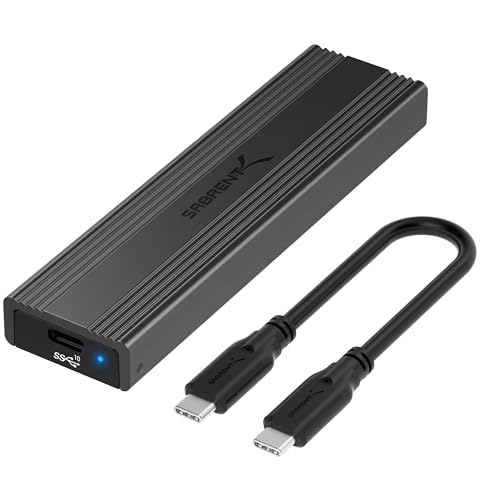
- Tool-free drive installation
- Supports NVMe and SATA M.2 sizes
- 10Gbps USB-C with slim aluminum build
Best For: IT teams performing frequent M.2 drive swaps
Best RAID Workhorse
Dual-Bay NVMe RAID SSD Enclosure

- RAID 0, RAID 1, JBOD, and Clone modes
- 20Gbps USB 3.2 transfer capability
- Tool-free dual-drive installation
Best For: Teams needing flexible RAID and cloning options
Best Smart Monitoring
DOCKCASE Explorer NVMe Enclosure

- Displays SSD health and usage information
- Around 10 seconds of power-loss protection
- 10Gbps USB-C with broad NVMe size support
Best For: Users who prioritize drive visibility and write protection
Best High-Capacity Hub

- Four bays for 2.5-inch and 3.5-inch SATA drives
- Up to 80TB total supported capacity
- Hot swapping with active fan cooling
Best For: Offices consolidating multiple SATA drives
Hybrid Capacity Powerhouse
8-Drive Hybrid HDD/NVMe Enclosure

- Holds four SATA drives and four M.2 NVMe SSDs
- Supports up to 152TB total capacity
- 10Gbps USB-C connectivity with no built-in RAID
Best For: Businesses needing mixed high-capacity and high-speed storage
Cool and Expandable

- Supports five 2.5-inch or 3.5-inch SATA drives
- Expands storage up to 110TB
- Includes aluminum housing and an 80mm cooling fan
Best For: Offices needing affordable multi-drive SATA expansion
Thunderbolt Performance Specialist
4-Bay Thunderbolt 3 NVMe Enclosure

- Holds four PCIe M.2 NVMe or AHCI SSDs
- Provides up to 40Gbps Thunderbolt 3 connectivity
- Supports software RAID and includes display output
Best For: Creative and technical teams needing fast NVMe workflows
Versatile M.2 Value – SSK M.2 NVMe/SATA Enclosure
For small businesses needing flexible ssd enclosures for small businesses, the SSK M.2 enclosure supports both NVMe PCIe and SATA M.2 drives in 2242, 2260, and 2280 sizes. Its 10Gbps USB 3.2 Gen 2 connection, included cables, and bus-powered design make it practical for moving files between compatible computers.
Best For: Offices that need one enclosure for multiple supported M.2 drive types and sizes.
Pros:
- Supports M.2 NVMe and SATA M-Key/B+M Key drives.
- Includes USB-C and USB-A cables, thermal pads, and a screwdriver.
- Aluminum shell, UASP/TRIM support, and plug-and-play compatibility across Windows, macOS, and Linux.
Cons:
- Does not support M.2 PCIe AHCI, mSATA, Wi-Fi, or capture-card devices.
- Requires a compatible M.2 SSD, which is not included.
This is a well-rounded choice for teams handling different M.2 upgrade or recovery drives, provided the SSD uses a supported interface and form factor.
Rugged Mobile Cooling – SHARGE M.2 NVMe Enclosure
The SHARGE enclosure is a compact option for small businesses that need portable ssd enclosures for small businesses with active cooling. Its built-in fan is designed to help maintain performance during large transfers, while the 10Gbps USB-C connection works with computers, smartphones, tablets, gaming systems, and other listed platforms.
Best For: Mobile teams transferring large files in demanding or outdoor work environments.
Pros:
- Built-in fan provides active heat dissipation during high-speed workloads.
- Lightweight 24 g design with IP54 protection and 6.6-foot drop protection.
- Includes write protection and broad operating-system and device compatibility.
Cons:
- Supports M-Key and 2230 NVMe SSDs only; B Key, B+M Key, SATA, and Nintendo Switch are not supported.
- Capacity is limited to up to 2TB, and the SSD is not included.
Its cooling, protection features, and small footprint make it particularly useful for field work, but buyers should verify their SSD is an M-Key 2230-compatible NVMe model.
Multi-Drive Workflow Hub – ORICO 4-Bay All-Flash Enclosure
For growing creative or technical teams, the ORICO enclosure combines multi-drive capacity with expansion ports. It is a strong candidate among ssd enclosures for small businesses that need centralized 2.5-inch storage, RAID flexibility, card-reader access, and fast USB connectivity for project files and backups.
Best For: Video editors, photographers, and offices managing several 2.5-inch SSDs or HDDs.
Pros:
- Supports seven RAID modes, including RAID 0, 1, 3, 5, 10, JBOD, and CLEAR.
- Offers four expansion ports, including two 10Gbps USB ports and SD/TF card slots.
- Supports up to 8TB per drive and up to 40TB across five bays according to the supplied specifications.
Cons:
- Designed for 2.5-inch drives and does not support 3.5-inch drives.
- Its multi-bay design is less portable than a single-drive enclosure.
This enclosure is better suited to a workstation or shared production setup than casual file transfers, especially where RAID configuration and card-based ingest can streamline daily work.
Tool-Free Everyday Choice – SABRENT NVMe/SATA M.2 Enclosure
The SABRENT EC-SNVE offers a straightforward solution for small businesses that regularly install, remove, or repurpose M.2 drives. This enclosure supports both NVMe and SATA M.2 SSDs in common 2242, 2260, and 2280 lengths, with tool-free installation and 10Gbps USB-C connectivity.
Best For: IT staff and small offices that need quick drive swaps without carrying a screwdriver.
Pros:
- Tool-free installation lets users insert or remove an SSD in seconds.
- Supports M.2 NVMe and SATA drives in 2242, 2260, and 2280 sizes.
- Slim aluminum and ABS construction includes a thermal pad and requires no external power or drivers.
Cons:
- Does not provide clearance for SSDs with pre-installed heatsinks.
- Not compatible with 2.5-inch SATA or mSATA drives.
- Only a USB-C-to-USB-C cable is listed in the box.
For routine upgrades, diagnostics, and data transfers, the tool-free design is the main advantage. Confirm the drive is a bare M.2 model before purchasing.
Best RAID Workhorse – Dual-Bay NVMe RAID SSD Enclosure
For small businesses comparing ssd enclosures for small businesses, this dual-bay NVMe model stands out when flexible storage management matters. It supports RAID 0, RAID 1, JBOD, and offline Clone mode, while its 20Gbps USB 3.2 connection suits large transfers and backups.
Best For: Small teams that need dual-drive flexibility, disk cloning, or RAID 1 redundancy.
Pros:
- Supports RAID 0, RAID 1, JBOD, and direct Clone mode.
- Tool-free installation makes drive replacement and cloning more convenient.
- 20Gbps transfer rate and aluminum construction support demanding workflows.
- Auxiliary USB-C input is designed to help support two high-capacity SSDs.
Cons:
- Designed for M.2 2280 NVMe SSDs rather than SATA drives.
- Its dual-bay design is more equipment than a single-drive user may need.
This is the most feature-rich choice of the three for businesses that value redundancy and cloning. RAID 1 is particularly useful for maintaining a second copy of important files, while Clone mode can simplify drive duplication.
Best Smart Monitoring – DOCKCASE Explorer NVMe Enclosure
This DOCKCASE model is a practical pick among ssd enclosures for small businesses when drive visibility and data protection are priorities. Its display reports SSD health, life, power-on count, and capacity, while the enclosure supports 10Gbps USB-C transfers and an approximately 10-second power-loss protection window.
Best For: Professionals who want at-a-glance SSD monitoring and added protection against write-data loss.
Pros:
- Built-in display shows drive health, remaining life, power-on times, and capacity.
- Power-loss protection can provide around 10 seconds for writing after power failure.
- Supports up to 10Gbps transfers with UASP and compatible NVMe media.
- Fits multiple NVMe sizes, including 2230, 2242, 2260, and 2280.
Cons:
- Supports one NVMe SSD rather than multiple drives.
- Its 10Gbps interface is slower on paper than the 20Gbps dual-bay alternative.
The smart display gives this enclosure a useful business-oriented advantage: staff can check basic drive information without relying entirely on a computer utility. Its thermal design and included USB-C cable further suit regular mobile or desktop use.
Best High-Capacity Hub – CENMATE 4-Bay SATA Enclosure
For businesses managing several SATA drives, this CENMATE unit offers a desktop-scale alternative within the ssd enclosures for small businesses category. Four bays accept 2.5-inch or 3.5-inch HDDs and SSDs, with up to 80TB total capacity, hot swapping, active cooling, and USB A/C connectivity.
Best For: Offices that need consolidated access to multiple SATA SSDs or hard drives without using a NAS or RAID enclosure.
Pros:
- Four bays support 2.5-inch and 3.5-inch SATA drives.
- Supports up to 80TB total capacity, with up to 20TB per drive.
- Hot-swappable bays allow drive changes without powering down.
- Includes a cooling fan, 12V power adapter, and USB A/C 3.0 cable.
Cons:
- It is a DAS enclosure with no RAID or NAS functionality.
- USB 3.0 transfer speed is rated at up to 5Gbps.
- The fan may produce approximately 40–50 decibels of noise.
This enclosure makes the most sense when capacity and multi-drive access matter more than NVMe speeds or built-in redundancy. Its tool-free, hot-swappable design can streamline rotating storage, but buyers should plan for desktop space and fan noise.
Hybrid Capacity Powerhouse – 8-Drive Hybrid HDD/NVMe Enclosure
For small businesses looking at SSD enclosures for small businesses, the TERRAMASTER D8 Hybrid 2 is designed for teams that need both fast NVMe storage and high-capacity SATA drives. Its eight independent bays support flexible expansion without requiring a built-in RAID setup.
Best For: Small businesses managing large media libraries, backups, active projects, and mixed HDD/SSD storage needs.
Pros:
- Supports four 3.5-inch SATA HDDs/SSDs and four M.2 2280 NVMe SSDs.
- Offers up to 152TB of stated total capacity.
- USB 3.2 Gen 2 Type-C connectivity delivers up to 10Gbps transfer rates.
- Includes power-saving and active modes, plus free TPC Backupper software.
Cons:
- Drives are not included.
- There is no built-in RAID; RAID requires third-party software.
- The enclosure is larger and more involved than a single-drive solution.
The D8 Hybrid 2 stands out when a business wants one enclosure for both capacity-focused HDDs and performance-focused NVMe SSDs. Its independent-drive design offers flexibility, but teams should plan their own backup and RAID strategy.
Cool and Expandable – 5-Bay SATA HDD/SSD Enclosure
The Yottamaster PS500C3 is a practical option among SSD enclosures for small businesses that rely on multiple 2.5-inch or 3.5-inch SATA drives. Five removable trays, active cooling, and up to 110TB of stated capacity make it useful for expanding desktop or laptop storage.
Best For: Small offices handling backups, archived files, video projects, and multiple SATA HDD or SSD volumes.
Pros:
- Supports up to five 2.5-inch or 3.5-inch SATA HDDs or SSDs.
- Provides up to 110TB of expanded capacity based on five 22TB drives.
- Aluminum construction and an 80mm fan help with heat management.
- Removable trays simplify drive installation and replacement.
Cons:
- This PS500C3 model has no hardware RAID.
- USB 3.1 Gen 1 connectivity is limited to 5Gbps, with stated SSD speeds up to 260MB/s.
- Total drive power consumption must remain within the 78W adapter limit.
This enclosure favors straightforward, high-capacity SATA expansion over maximum interface speed or integrated RAID. It is a sensible fit for businesses comfortable managing individual disks or configuring software RAID through their operating system.
Thunderbolt Performance Specialist – 4-Bay Thunderbolt 3 NVMe Enclosure
For demanding workflows, the StarTech M2E4BTB3 is one of the more performance-focused SSD enclosures for small businesses. It connects up to four PCIe M.2 NVMe or AHCI drives over Thunderbolt 3 and supports software RAID for teams working with large files.
Best For: Video editors, designers, developers, and other teams that need fast multi-drive NVMe storage over Thunderbolt.
Pros:
- Supports up to four 80mm M-Key PCIe M.2 NVMe or AHCI SSDs.
- Thunderbolt 3 provides data transfer rates up to 40Gbps.
- Supports software RAID through Windows, macOS, and Linux storage tools.
- Includes cooling hardware, a 72W power supply, DisplayPort output, and a downstream Thunderbolt port.
Cons:
- It is not compatible with SATA SSDs.
- Full performance requires a compatible Thunderbolt 3 or Thunderbolt 4 host.
- Connected displays and downstream devices share bandwidth with the SSDs.
The M2E4BTB3 is best suited to specialized, high-throughput work rather than general-purpose storage expansion. Businesses should verify Thunderbolt compatibility and choose an appropriate software RAID configuration before deployment.
How We Picked the Best SSD Enclosures for Small Businesses
We evaluated these enclosures by looking at the factors that matter most in office, studio, and small-team environments: drive compatibility, interface speed, expansion capacity, cooling, installation, RAID support, and practical portability. The selection includes M.2 NVMe and SATA models, 2.5-inch and 3.5-inch drive bays, multi-drive enclosures, and premium Thunderbolt hardware.
Because business storage needs vary widely, no single enclosure is ideal for every buyer. A compact USB-C enclosure may be best for one-drive backups, while a multi-bay unit can provide centralized working storage or added redundancy.
Quick Comparison
| Use case | Best enclosure type | What to prioritize |
|---|---|---|
| Portable file transfers | Single M.2 enclosure | 10Gbps USB, durable construction, tool-free installation |
| High-speed creative work | Thunderbolt or 20Gbps NVMe enclosure | Bandwidth, cooling, host-device compatibility |
| Shared local storage | Multi-bay SATA enclosure | Drive capacity, fan control, hot swapping, RAID |
| Mixed SSD and HDD expansion | Hybrid enclosure | Bay flexibility, power delivery, storage management |
Key Buying Factors for SSD Enclosures for Small Businesses
Drive and Interface Compatibility
Check whether the enclosure supports NVMe, SATA, or both. M.2 drives also use different key layouts, so confirm support for your specific M-key or B+M-key SSD. A USB-C connector does not automatically mean NVMe support or maximum-speed operation.
Speed and Host Compatibility
Rated speeds such as 10Gbps, 20Gbps, and 40Gbps describe the connection ceiling, not guaranteed file-transfer performance. Your computer, cable, drive, and operating system must all support the same standard. For routine backups, 10Gbps is often sufficient; demanding video, photography, and large project workflows may benefit from 20Gbps or Thunderbolt.
Capacity, RAID, and Redundancy
Single-drive enclosures are simple and portable, but multi-bay models offer greater capacity and options such as RAID 0, RAID 1, or JBOD. RAID 1 can improve resilience against one drive failure, while RAID 0 prioritizes speed at the cost of redundancy. RAID is not a substitute for a separate backup.
Cooling and Reliability
High-performance NVMe drives and densely populated bays can generate substantial heat. Look for aluminum construction, heatsinks, thermal pads, or active fans. For an enclosure that will run continuously, also consider fan noise, ventilation, power supply quality, and warranty coverage.
Installation and Administration
Tool-free access, hot swapping, clone modes, status displays, and clear drive indicators can save time for a small team. Verify whether RAID configuration requires software, a hardware switch, or a reformat, and confirm that the enclosure works with your preferred operating systems.
Who Should Buy Which SSD Enclosures for Small Businesses?
- Choose a compact M.2 enclosure for portable backups, field work, drive recycling, and quick transfers between computers.
- Choose a dual-bay RAID enclosure if you need cloning, mirrored storage, or a flexible two-drive workstation setup.
- Choose a four- or five-bay SATA enclosure for affordable high-capacity storage using multiple 2.5-inch or 3.5-inch drives.
- Choose a hybrid enclosure when your business uses both high-speed NVMe SSDs and larger SATA disks.
- Choose a Thunderbolt enclosure for compatible Macs or workstations handling large media projects where maximum sustained bandwidth matters.
Before buying, confirm the enclosure’s supported drive types, included cable and power requirements, operating-system compatibility, and return policy. For business-critical data, pair any enclosure with scheduled backups and, when appropriate, off-site or cloud copies.