Fast external storage can make a noticeable difference when you are editing high-bitrate footage, moving large project files, or working between multiple computers. The right enclosure lets you turn a compatible M.2 or SATA SSD into a portable editing drive without paying for a prebuilt external SSD.
We selected 10 enclosures across USB4, Thunderbolt-compatible, USB 3.2, NVMe, and SATA categories. The guide below explains which features matter most for sustained video workflows and helps match each design to your editing setup.
Best 10 SSD Enclosures for Video Editing Picks for 2026
Future-Ready Speed Pick
ACASIS 80Gbps M.2 NVMe Enclosure

- Up to 80Gbps connectivity
- Active intelligent cooling fan
- 60W laptop power delivery
Best For: Thunderbolt 5 and USB4 V2 editing workstations
High-Capacity Array Pick
ORICO 5-Bay All-Flash Enclosure

- Five 2.5-inch drive bays
- Seven selectable RAID modes
- USB, SD, and TF expansion
Best For: Large video libraries and multi-drive editing setups
Thermal Design Pick
UGREEN 80Gbps M.2 NVMe Enclosure

- Advertised speeds up to 7000 MB/s
- Finned aluminum heat dissipation
- Supports four M.2 NVMe sizes
Best For: Portable high-speed editing with passive cooling
Reliable Active-Cooling Pick

- 40Gbps transfer interface
- Switch-activated cooling fan
- Supports multiple M.2 sizes
Best For: Mac and PC editors with sustained transfer workloads
Fastest Gen5 Pick

- Up to 80Gbps over Thunderbolt 5
- LCD temperature and fan monitoring
- Active cooling; supports up to 8TB
Best For: Thunderbolt 5 video editors handling large NVMe projects
Multi-Drive Editing Station

- Four M.2 NVMe bays
- Up to 32TB total capacity
- USB4 bandwidth and active cooling
Best For: Editors and DITs managing multiple NVMe project drives
Best Flexible Budget Option
SABRENT Tool-Free M.2 Enclosure
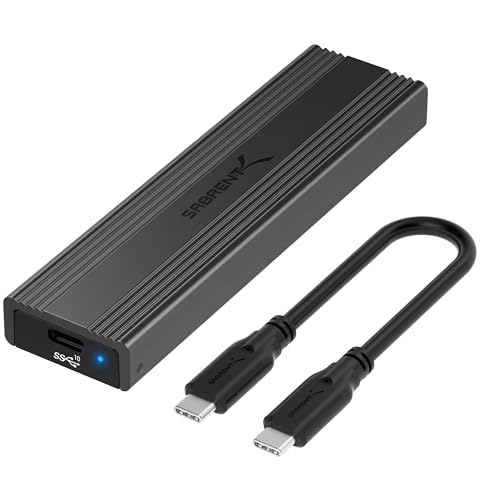
- Supports NVMe and SATA M.2 drives
- Tool-free drive installation
- 10Gbps USB-C with slim aluminum case
Best For: Portable everyday editing storage and drive reuse
Best Overall
Yottamaster 40Gbps NVMe Enclosure

- USB4/Thunderbolt 4 with up to 40Gbps connectivity
- Active fan cooling for sustained editing workloads
- Tool-free support for NVMe SSDs up to 8TB
Best For: USB4 and Thunderbolt 4 video editing setups
Best Versatility
ASUS ROG Strix Aiolos Enclosure

- Supports both NVMe PCIe and SATA M.2 SSDs
- USB 3.2 Gen 2x2 reaches up to 20Gbps
- Tool-free design with thermal pad and SSD monitoring
Best For: Editors using multiple M.2 drive types
Best Silent Design
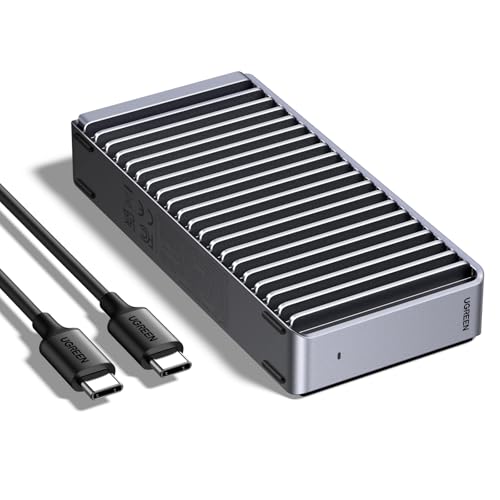
- Fanless finned aluminum cooling design
- Up to 40Gbps with USB4 and Thunderbolt compatibility
- Supports NVMe drives up to 8TB
Best For: Quiet editing workstations and portable workflows
Future-Ready Speed Pick – ACASIS 80Gbps M.2 NVMe Enclosure
For editors seeking high-performance ssd enclosures for video editing, the ACASIS TB501 MAX pairs an 80Gbps connection with support for PCIe 5.0 NVMe drives. Its active cooling and 60W power delivery make it especially suited to demanding mobile workstation setups.
Best For: Video editors using Thunderbolt 5 or USB4 V2 laptops who need fast transfers, active cooling, and laptop charging through one connection.
Pros:
- Supports up to 80Gbps connectivity and advertised speeds up to 6000 MB/s with a suitable PCIe 4.0 x4 SSD.
- Built-in intelligent fan helps manage heat during sustained workloads.
- 60W power delivery can charge a compatible laptop while the enclosure is in use.
- Tool-free installation supports M.2 NVMe sizes through the included adapter and accessories.
Cons:
- Not compatible with Thunderbolt 3 devices.
- Requires a compatible high-speed SSD and host connection to reach its top performance.
- The enclosure can become warm during large transfers and should be used in a ventilated area.
The ACASIS is the most forward-looking option here, but its benefits depend on having newer Thunderbolt 5 or USB4 V2 hardware. It is a strong choice for creators building a fast, expandable editing setup.
High-Capacity Array Pick – ORICO 5-Bay All-Flash Enclosure
The ORICO 5-bay enclosure takes a different approach to ssd enclosures for video editing: instead of a single portable NVMe drive, it combines five 2.5-inch bays with RAID options, card readers, and USB expansion. It is designed for editors managing large libraries and multiple project drives.
Best For: Video production teams and photographers who need expandable multi-drive storage, RAID flexibility, and convenient card access.
Pros:
- Supports up to five 2.5-inch SSDs or HDDs, with up to 40TB total capacity.
- Offers seven modes, including RAID 0, 1, 3, 5, 10, JBOD, and CLEAR.
- Includes two USB 3.2 10Gbps ports plus SD and TF 3.0 card slots.
- Its 2.5-inch all-flash design is more portable and shock-resistant than traditional 3.5-inch enclosures.
Cons:
- Its SATA-linked transfer rate is listed at 5Gbps, below the 10Gbps USB interface ceiling.
- It does not accept 3.5-inch drives.
- Using multiple bays and RAID modes requires more setup than a single-drive enclosure.
The ORICO is best viewed as a compact storage hub rather than a pocket-sized scratch disk. Its capacity, RAID choices, and card slots make it appealing when project organization and backup flexibility matter more than maximum single-drive speed.
Thermal Design Pick – UGREEN 80Gbps M.2 NVMe Enclosure
UGREEN’s 80Gbps enclosure targets editors who want a compact NVMe solution for demanding file transfers. Its dual-chip design and finned aluminum cooling structure are intended to support high throughput while keeping sustained workloads more manageable.
Best For: Mac, Windows, Linux, or Android users with newer Thunderbolt or USB4 systems who prioritize speed and passive heat management.
Pros:
- Advertises transfer speeds up to 7000 MB/s with its dual-chip architecture.
- Double-sided aluminum fins and a 3D cooling design improve heat dissipation.
- Supports M.2 2230, 2242, 2260, and 2280 NVMe drives up to 8TB.
- Compact aluminum construction is suitable for travel and mobile editing.
Cons:
- Does not support SATA or mSATA SSDs.
- SSDs with pre-installed heatsinks are not supported, and thicker drives may require a thinner thermal pad.
- Top speeds depend on the host device, SSD, and connection.
With broad M.2 size support and a carefully designed aluminum cooling system, the UGREEN is a versatile choice for editors who prefer a slim enclosure without a built-in fan. Check SSD thickness and host compatibility before buying.
Reliable Active-Cooling Pick – ACASIS 40Gbps NVMe Enclosure
The ACASIS TBU405 Pro is a practical option among ssd enclosures for video editing when sustained performance and broad device compatibility matter. Its 40Gbps interface, aluminum body, and switch-activated cooling fan are designed for large footage transfers and extended editing sessions.
Best For: Editors moving between Mac and PC systems who need active cooling, 40Gbps Thunderbolt performance, and support for several M.2 drive sizes.
Pros:
- Advertised read and write speeds reach up to 2805 and 2734 MB/s in the supplied test example.
- Built-in fan and aluminum heat dissipation help reduce thermal throttling during heavy workloads.
- Supports Thunderbolt 5, 4, and 3, USB4, USB 3.2, USB 3.1, and USB 3.0 connections.
- Accepts M.2 2230, 2242, 2260, and 2280 NVMe drives up to 8TB.
Cons:
- The fan must be activated with its switch.
- Its 40Gbps ceiling is lower than the 80Gbps models in this roundup.
- It is an enclosure only, so an NVMe SSD is required separately.
The TBU405 Pro offers a sensible balance for creators whose computers top out at 40Gbps or who value broad backward compatibility. Its active cooling is particularly useful for long transfers, provided you remember to turn the fan on.
Fastest Gen5 Pick – MOKiN 80Gbps NVMe Enclosure
For editors moving large footage libraries, the MOKiN is one of the most performance-focused SSD enclosures for video editing. Its Thunderbolt 5 connection supports up to 80Gbps with compatible hardware, while the display and active cooling help you monitor demanding transfers.
Best For: Editors with Thunderbolt 5 systems who want high-speed transfers, active cooling, and support for large NVMe project drives.
Pros:
- Supports up to 80Gbps with Thunderbolt 5 and compatible PCIe Gen5 SSDs.
- LCD shows temperature status and fan speed during transfers.
- Built-in fan starts at 40°C to help limit thermal throttling.
- Supports NVMe drives up to 8TB in several M.2 sizes.
Cons:
- 80Gbps performance requires a Thunderbolt 5 port and cable.
- Not compatible with SATA M.2 SSDs.
- Actual speeds depend on the computer, connection, and installed SSD.
The MOKiN combines extreme interface bandwidth with useful thermal monitoring. It makes the most sense for high-end workflows where the host computer and SSD can take advantage of its Gen5 and Thunderbolt 5 capabilities.
Multi-Drive Editing Station – ORICO 40Gbps M.2 Dock
The ORICO 8848U4 takes a different approach to SSD enclosures for video editing: it houses up to four M.2 NVMe drives instead of one. With up to 40Gbps of USB4 bandwidth, built-in cooling, and up to 32TB of total capacity, it is designed for larger media-storage setups.
Best For: Production teams, DIT professionals, and editors who need several NVMe drives in one portable enclosure.
Pros:
- Supports four M.2 NVMe SSDs, with up to 8TB per drive.
- Offers up to 32TB total capacity and up to 40Gbps USB4 bandwidth.
- Aluminum housing, fan, and vents support sustained workloads.
- Compact solid-state design is easier to transport than a conventional 3.5-inch enclosure.
Cons:
- SSDs are not included.
- Single-drive operation is rated up to 10Gbps, not the full 40Gbps aggregate bandwidth.
- Fan noise is specified below 30 decibels, so operation is not completely silent.
This is better viewed as a compact multi-drive workstation than a simple portable drive case. It is especially useful when your editing workflow benefits from separate media, backup, or project drives in one enclosure.
Best Flexible Budget Option – SABRENT Tool-Free M.2 Enclosure
The SABRENT EC-SNVE is a straightforward choice for editors who already own an M.2 drive and want a compact enclosure. It supports both NVMe and SATA M.2 SSDs, installs without tools, and uses USB 3.2 Type-C for transfers up to 10Gbps.
Best For: Editors who want an affordable, portable enclosure for repurposing compatible M.2 NVMe or SATA drives.
Pros:
- Supports both M.2 PCIe NVMe and M.2 SATA SSDs.
- Tool-free installation makes swapping drives quick.
- USB 3.2 Type-C supports up to 10Gbps and is backward compatible.
- Slim aluminum build includes a thermal pad and requires no external power.
Cons:
- It is an enclosure only; an SSD is not included.
- It cannot fit drives with pre-installed heatsinks.
- It does not support 2.5-inch SATA drives or mSATA.
The SABRENT is not aimed at Thunderbolt-level performance, but its broad M.2 compatibility and tool-free design make it practical for everyday editing transfers, scratch storage, and drive reuse.
Best Overall – Yottamaster 40Gbps NVMe Enclosure
For demanding video editing, the Yottamaster is one of the fastest SSD enclosures for video editing in this roundup. Its USB4 and Thunderbolt 4 compatibility, active cooling fan, and ASM2464PD controller are designed for sustained transfers and 4K workflows.
Best For: Editors using USB4 or Thunderbolt 3/4 systems who want high sustained performance and active cooling.
Pros:
- 40Gbps connectivity with typical real-world read/write speeds of 2800–3200 MB/s under suitable conditions
- Active cooling fan, aluminum construction, and overcurrent and overheating protection
- Tool-free installation for 2230, 2242, 2260, and 2280 NVMe SSDs up to 8TB
- Transparent cover makes the power/activity LED and fan status easy to see
Cons:
- Requires a compatible 40Gbps host and cable for top performance
- Supports NVMe drives rather than SATA SSDs
The Yottamaster is a strong pick when editing performance matters more than basic portability. Just verify your computer and cable support USB4 or Thunderbolt 4 before expecting its highest speeds.
Best Versatility – ASUS ROG Strix Aiolos Enclosure
The ASUS ROG Strix Aiolos is a versatile choice among SSD enclosures for video editing, especially if you have different M.2 drives to use. Its USB-C 3.2 Gen 2×2 interface reaches up to 20Gbps, while support for both NVMe PCIe and SATA formats simplifies drive reuse.
Best For: Editors who need one compact enclosure for both M.2 NVMe PCIe and SATA SSDs.
Pros:
- Supports M.2 NVMe PCIe and SATA SSDs in 2242, 2260, and 2280 sizes
- USB 3.2 Gen 2×2 provides transfer speeds up to 20Gbps
- Internal thermal pad helps dissipate heat during use
- Tool-free push-to-open design and ROG SSD Dashboard monitoring
Cons:
- Its 20Gbps interface is slower than the 40Gbps models in this roundup
- ROG SSD Dashboard is intended for supported Windows environments
The Aiolos trades maximum bandwidth for broader drive compatibility and convenient monitoring. It is a practical option for editors moving between NVMe and SATA M.2 storage rather than chasing the fastest possible transfers.
Best Silent Design – UGREEN 40Gbps NVMe Enclosure
UGREEN’s enclosure is a strong fit for video editors who want high-speed external storage without fan noise. It uses a 40Gbps USB4 design with an ASM2464PD chip and a double-sided fin cooling structure intended to improve heat dissipation during large file transfers.
Best For: Editors who prioritize quiet operation, portability, and high-speed NVMe storage.
Pros:
- Up to 40Gbps connectivity and claimed maximum speeds of 3600MB/s with the right setup
- Fanless double-sided fin design provides quiet heat dissipation
- Supports 2230, 2242, 2260, and 2280 NVMe drives up to 8TB
- Compatible with USB4, Thunderbolt 3/4, and multiple USB generations
Cons:
- NVMe only; SATA NGFF and mSATA drives are not supported
- Requires Thunderbolt 4 cables and devices for the stated 3600MB/s maximum
- SSD is not included, and unusually thick drives may require a thinner thermal pad
The UGREEN is appealing for quiet editing bays and travel kits where a fan is undesirable. Its real-world performance will depend heavily on the installed SSD, host, cable, and cooling setup.
How We Picked These SSD Enclosures for Video Editing
We focused on the factors that affect real editing work rather than headline speed alone. That includes interface bandwidth, NVMe or SATA compatibility, sustained performance, thermal management, portability, installation convenience, and compatibility with modern computers. We also considered useful extras such as cooling fans, displays, power delivery, USB hubs, tool-free installation, and support for large-capacity SSDs.
Advertised transfer rates are theoretical maximums. Actual results depend on the installed SSD, host port, cable, file sizes, thermals, and operating system, so we favored products with practical features that help maintain consistent performance.
Quick Comparison
| Type | Best For | What to Expect |
|---|---|---|
| 80Gbps USB4 or USB4 V2 | High-end 4K and 8K workflows | Top performance with compatible hosts, cables, and SSDs |
| 40Gbps USB4 or Thunderbolt-compatible | Fast professional editing | Excellent throughput and broad modern-device compatibility |
| 20Gbps USB 3.2 | General editing and transfers | Good speed without requiring USB4 hardware |
| SATA or mixed-interface models | Existing drives and flexible upgrades | Lower maximum speed, but wider drive compatibility |
Key Buying Factors for SSD Enclosures for Video Editing
Interface and Host Compatibility
Choose an enclosure that matches the fastest port on your computer. An 80Gbps enclosure is only worthwhile if your system, cable, and SSD can use that bandwidth. USB4 and Thunderbolt-compatible models are strong choices for newer laptops, while 20Gbps USB-C options can be more practical for older systems.
NVMe, SATA, and Drive Size
NVMe enclosures generally provide much higher performance than SATA models, especially for large media caches and active project files. Check whether the enclosure supports M.2 2280 drives and which key types it accepts. A dual NVMe/SATA design is useful if you already own several types of SSD, but it may sacrifice some speed or compactness.
Cooling and Sustained Performance
Video transfers and timeline work can keep an SSD busy for long periods. A metal body, thermal pad, heatsink, or built-in fan can reduce throttling. Cooling is particularly important for high-performance PCIe Gen4 and Gen5 drives, which generate more heat than basic SSDs.
Power, Cables, and Convenience
Verify the included cable and connector standards before buying. Tool-free access simplifies drive swaps, while a display can show temperature or speed at a glance. Power-delivery support and USB hubs may be valuable at a desk, but they add features that mobile editors may not need.
Who Should Buy Which SSD Enclosures for Video Editing?
Choose an 80Gbps model if you have a compatible USB4 V2 or similarly fast system and regularly handle large 4K or 8K files. A 40Gbps enclosure is the better balance for most professional editors using USB4 or Thunderbolt 4. If your computer has a 20Gbps USB-C port, a USB 3.2 enclosure can deliver strong value without paying for unused bandwidth.
Buy a cooling-focused enclosure for long exports, multicamera projects, and frequent sustained transfers. Pick a tool-free or dual-interface model if you change drives often or need to reuse SATA and NVMe SSDs. For occasional editing, backups, and portable project storage, prioritize reliability, compact size, and compatibility over the highest advertised speed.